In a nutshell
- 🌿 Banana peel can deter aphids on roses by masking host odours; peel volatiles and compounds like phenolics, tannins, and volatile esters act as short-lived behaviour disruptors.
- 🛠️ Safe use: cut peel into small pieces, rinse sugars, and tuck under mulch 5–10 cm from stems; never press against the crown; refresh every 2–5 days and pair with a strong water jet and predator support.
- 🧪 Chemistry matters: peel provides potassium for plant vigour but it’s not a true repellent; most insect-active effects are close-range and fleeting, strongest with fresh material.
- ⚠️ Know the limits: exposed peels can attract rodents and slugs and foster mould in wet conditions; compost when in doubt, and note that bodies like the RHS don’t list peel use among formal controls.
- 🧭 Go integrated: layer disruption (peel), removal (water), and predation (ladybirds, hoverflies) within Integrated Pest Management (IPM) for reliable, low-chemical control.
Gardeners love a thrifty trick, and the notion that tucking a banana peel around rose stems keeps aphids at bay has rippled through allotments and social feeds alike. It sounds delightfully simple. Waste not, want not. But does it stand up? The answer, as ever with nature, sits between chemistry and context. Banana peel carries a cocktail of plant-derived compounds that can alter insect behaviour and influence soil life, yet it can also invite trouble if used carelessly. This article unpacks the science behind the scent, the practicalities of deployment, and the limits of the method, so you can decide when—if at all—to try it.
Why Banana Peel Might Deter Aphids
Aphids locate hosts by reading a complex blend of leaf volatiles and visual cues. Disrupt the odour profile and you sometimes interrupt the feast. Banana peel releases a mild, fruity odour alongside a suite of phenolics and other plant secondary metabolites. Those compounds can mask or confuse the chemical signals that aphids use to home in on tender rose shoots. Some lab studies on peel extracts show antifeedant or insecticidal effects against certain insects, lending plausibility to the remedy. However, direct, peer-reviewed evidence for banana peel repelling aphids on roses remains limited and largely anecdotal.
There’s also a simple physical dimension. A fresh peel has a tacky inner surface and, when lightly pressed into mulch, can create a temporary barrier around the stem base. That ring complicates access for ants that “farm” aphids for honeydew, a relationship that often worsens infestations. If ants are deterred, aphids become less protected and more vulnerable to predators. Think of banana peel as a short-term cue disruptor and barrier, not a silver bullet. It may nudge the balance towards your roses, especially early in the season when sap is rising and new growth is irresistible.
The Chemicals at Work: From Phenolics to Potassium
Banana peel chemistry is surprisingly rich. Alongside its well-known potassium, the skin holds phenolic acids, flavonoids, tannins, traces of saponins and alkaloids, organic acids, and fragrant esters. In insect ecology, such compounds can act as antifeedants, behaviour modifiers, or digestibility reducers. They don’t turn the soil into a pesticide, but in close quarters they can shift insect choices. Below is a compact guide to what’s in play and why it might matter near roses.
| Compound Class | Examples in Peel | Proposed Pest Effect | Notes for Gardeners |
|---|---|---|---|
| Phenolics/Flavonoids | Catechins, gallic acid (varies) | May deter feeding; antioxidant | Local effect; strongest in fresh material |
| Tannins | Condensed tannins | Astringent; can reduce palatability | Break down over days in warm, moist mulch |
| Saponins/Alkaloids | Trace levels | Cell-membrane and taste effects | More evident in extracts than raw peel |
| Volatile Esters | Fruity esters (e.g., isoamyl acetate) | Masks host plant odours | Short-lived; fades within 24–72 hours |
| Potassium | K-rich minerals | Improves plant vigour and stress tolerance | Longer-term soil benefit; not a repellent |
The headline is simple: banana peel chemistry can influence insect behaviour at very close range, but effects are transient. Any protective impact should be considered a nudge. For sustained control, you’ll need an integrated approach that enlists predators and good husbandry while keeping chemical inputs to a minimum.
How to Use Banana Peel Safely Around Roses
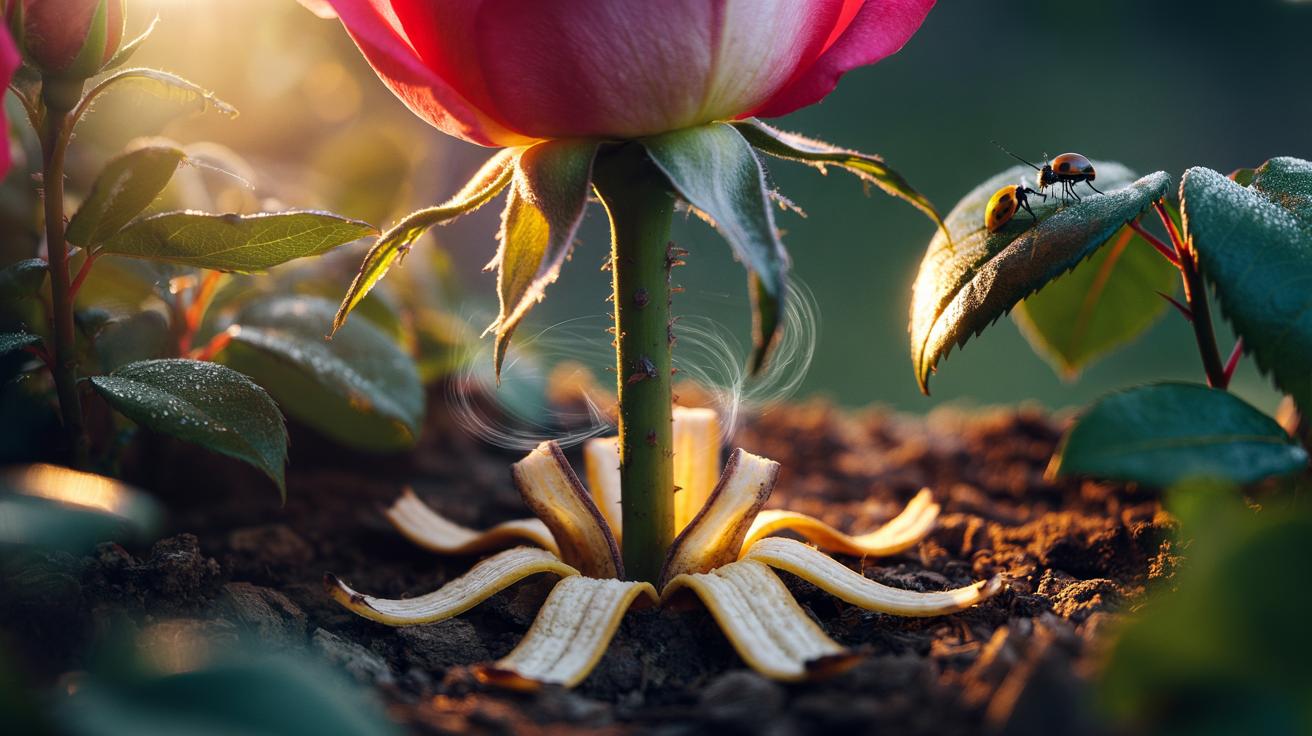
Keep it tidy, targeted, and temporary. First, slice fresh peels into narrow strips or small squares. Rinse them briefly to remove surface sugars that might lure slugs or wasps. Then, tuck the pieces under mulch, forming a loose ring 5–10 cm from the stem. Do not pile against the crown. Never wedge whole peels directly against woody stems; that traps moisture and invites rot. In cool, damp British weather, replace after three to five days. In hot spells, the scent fades faster; refresh within two days if you’re trialling continuous coverage.
Pair the tactic with simple, evidence-backed steps. Blast colonies off with a sharp jet of water early in the day. Encourage ladybirds, hoverflies, and lacewings by planting nectar-rich umbels and avoiding broad-spectrum sprays. Check for ant trails; a sprinkle of inert barriers like diatomaceous earth on hard surfaces can slow them without harming the bed. If ants persist, address nests away from the roses. Think layers: disruption (peel), removal (water), and predation (beneficials) work better together than any single trick.
Limits, Risks, and What the Science Says
Truth in gardening often rests on scale and context. A couple of discreet peel pieces can be harmless; a heap can become a headache. Exposed peels may attract rodents or urban foxes, especially in city gardens. Slugs appreciate the feast too. Over wet soil, decomposing skins can foster moulds and create slimy patches that you’ll regret. If you have rat pressure—or you share a boundary with a neighbour who does—skip raw peels and compost them fully before use. When in doubt, compost first, then mulch.
On the evidence, the picture is cautious. Studies support insect-active compounds in banana peel extracts, but field-grade data for aphids on roses are scarce. UK guidance from organisations like the RHS emphasises cultural controls, biological allies, and, where necessary, targeted soaps or oils—banana peel doesn’t feature among formal recommendations. That doesn’t make it useless; it makes it optional. Use it as an experiment, note results across a fortnight, and be ready to pivot. Integrated pest management remains the bedrock: healthy plants, diverse predators, and minimal disturbance.
Banana peel around rose stems sits at the intersection of folk wisdom and plausible chemistry. It may deter aphids briefly by scrambling scent cues and hindering ant attendants, and as it breaks down it can feed the soil modestly with potassium. Yet the method is patchy, perishable, and not risk-free. If you try it, keep pieces small, hidden under mulch, and away from the stem, and combine with water jets, predators, and vigilant scouting. In your own beds, what blend of quick fixes and long-term habits has delivered the cleanest, bloom-heavy roses without resorting to harsh sprays?
Did you like it?4.4/5 (30)