In a nutshell
- 🧂 Pop an open box of baking soda (bicarbonate of soda) into musty cupboards to neutralise odours overnight—cheap, non-toxic, and fragrance-free.
- 🦠 Smells build from limited airflow, humidity, and porous materials trapping volatiles; clean and dry surfaces first to cut the source of odour.
- ⚗️ It works by mild alkalinity (pH ~8.3) that neutralises acidic odours, plus light adsorption of vapours and moisture; more exposed surface = faster results in 8–24 hours.
- 🧭 Steps: clear and dry the cupboard, open the box wide or decant into a shallow dish, place centrally (not against walls), close the door overnight; for stubborn smells, use two boxes and shake to refresh crystals.
- ♻️ Maintenance: replace every 30–60 days (monthly under-sink), reuse spent powder for light cleaning, keep away from children/pets, and fix moisture sources for lasting freshness.
Musty cupboards are stubborn. You crack the door and the stale air pushes back, hinting at humidity, forgotten spills, and tightly sealed spaces. Yet the fix can be almost laughably simple: open a box of baking soda—or, as we say in the UK, bicarbonate of soda—and let chemistry do the heavy lifting. Leave it in place overnight and you’ll often wake to a cupboard that smells cleaner, quieter, less intrusive. This isn’t perfume; it’s removal. By buffering acidic whiffs and soaking up trace moisture, bicarbonate cuts through the fug without masking it. It’s cheap, non-toxic, and brilliantly low effort, which makes it a staple in homes where freshness matters and fuss doesn’t.
Why Cupboards Smell Musty
Closed cupboards develop odours because air exchange is limited, humidity lingers, and porous materials trap volatile molecules. Wood, paper packaging, and fabrics absorb everyday smells—cooking vapours, detergents, even tannins and resins from the cabinet itself. Add a little moisture from a steamy kitchen or a damp cloth tossed inside and you create a microclimate where microbes thrive. Their metabolic by-products are what we call musty. Odour is a symptom; the cause is stale air, moisture, and chemistry conspiring in a small space.
There’s also the issue of accumulation. Tiny spill? It evaporates, but not entirely, leaving residues that gradually outgas. Plastic tubs and bin liners emit trace compounds, too. Over days and weeks, the molecules build until you notice them every time the door swings open. The remedy starts with ventilation and dryness—wipe surfaces, dry thoroughly, and avoid storing damp items—but a passive sorbent helps to mop up what’s left. That’s where bicarbonate earns its keep: neutralising odour-active acids and moderating humidity while you carry on with your day.
How Baking Soda Absorbs Odours Overnight
Bicarbonate of soda is an amphoteric salt with a mild alkalinity (around pH 8.3 in solution). Many household odours lean acidic—think acetic or butyric notes—so bicarbonate neutralises them by reacting at the surface of its crystals. It also shows limited physical adsorption of volatile compounds and a gentle moisture uptake that reduces the air’s ability to ferry smells. In a closed cupboard, the concentration of odour molecules is relatively high. Open the box, spread the crystals to expose more surface, and diffusion does the rest.
Is it magic overnight? Not quite—just fast chemistry in a small volume. In 8–12 hours you’ll often perceive a striking reduction because bicarbonate blunts the sharpest notes quickly. Deeper, long-embedded smells may take 24–72 hours, and persistent damp will keep re-seeding the air regardless. That’s why the best results come from a two-part approach: dry and clean the space, then deploy the baking soda as a buffer. For especially stubborn cupboards, use two open boxes or decant into shallow bowls to increase exposed surface area and speed.
Step-by-Step: Deodorise a Cupboard with One Box
Clear the cupboard first. Remove food, textiles, and plastics. Wipe shelves with a mild solution—warm water and a splash of white vinegar—then dry thoroughly with a clean towel. You’re not trying to perfume the space; you’re stripping away residues so bicarbonate can tackle the volatile leftovers. Now take a fresh, unopened baking soda box (200–250 g). Open the perforated panel or slice a wide flap; bigger openings mean better contact with the air.
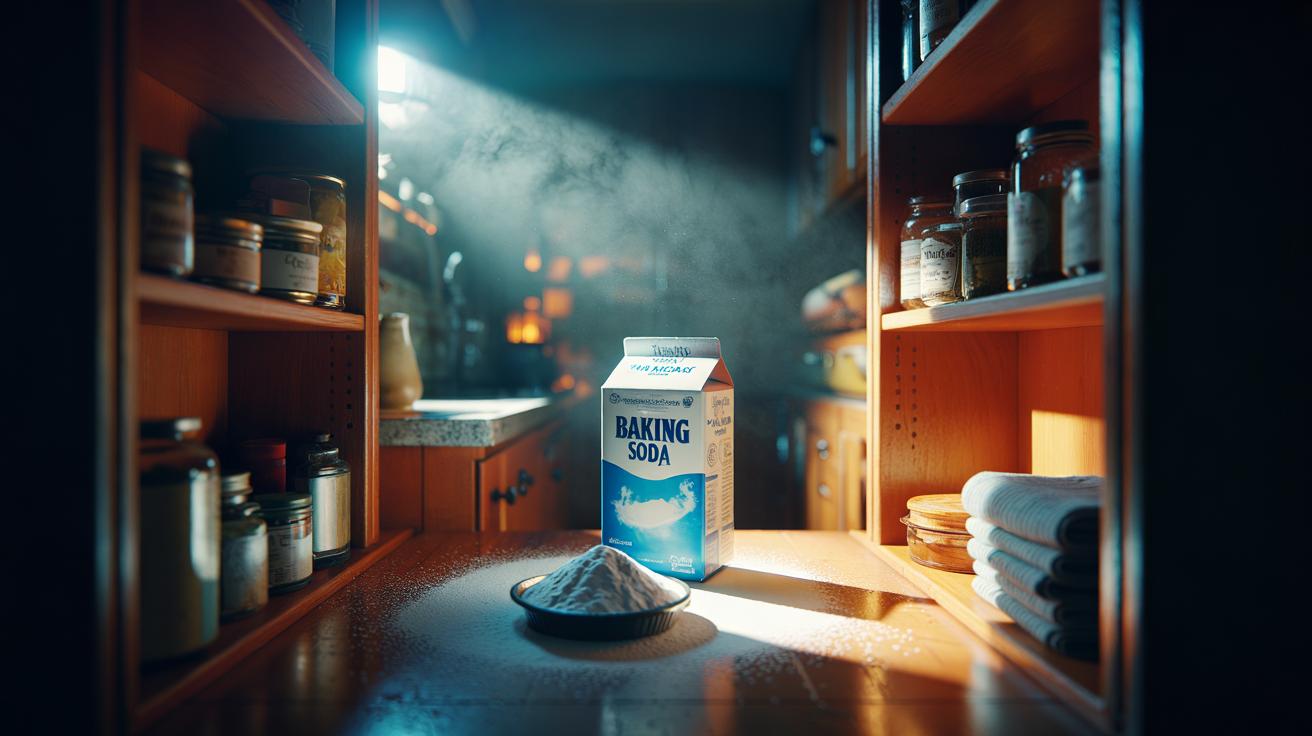
Place the box central to the space, ideally mid-shelf, and avoid pushing it tight against walls where airflow stalls. Close the door and leave overnight—12 hours is good, 24 hours better. Return, sniff test, and, if needed, give the box a shake to expose fresh crystals. For heavy odours, tip half the contents into a shallow dish for more surface. Replace the box every 30–60 days in problem cupboards; label the date so you don’t forget. Do not reuse for cooking. When spent, sprinkle it into the sink and run warm water for a mini scrub, or shake over the bin and rinse—handy, clean, and waste-free.
Smart Placement, Reuse, and Safety
Right amount, right location, right rhythm. That’s the recipe for consistent freshness. In tiny spice cupboards, half a cup in a ramekin works wonders. Under-sink cabinets, with pipework and bins, often need a full box plus a backup bowl near the door. Wardrobes thrive on one box per metre of hanging rail, placed high and low to catch convection currents. And remember the trigger: if the cupboard hosts damp mops, wet cloths, or warm appliances, address those first or even the best bicarbonate will chase its tail.
| Cupboard Type | Amount | Placement | First Check | Replace |
|---|---|---|---|---|
| Small spice cupboard | 1/2 cup | Centre shelf | 12–24 hrs | Every 60 days |
| Standard kitchen cupboard | 1 box (200–250 g) | Middle, not against walls | 24 hrs | Every 30–45 days |
| Under-sink cabinet | 1–1.5 boxes | One near pipes, one by door | 12–24 hrs | Every 30 days |
| Wardrobe | 2 boxes | Top and lower shelf | 24–48 hrs | Every 45–60 days |
Reuse the old powder for low-stakes jobs: deodorise the bin, freshen a doormat before vacuuming, or clean stainless-steel sinks. If you spot visible mould, or the air feels damp no matter what, tackle the moisture source—leaks, poor ventilation—before relying on sorbents. Bicarbonate is safe around food storage, but keep it away from children and pets as you would any household product, and never treat it as a substitute for fixing water ingress or airflow.
One open box, one closed space, one quiet night. That’s often all it takes to turn a stale cupboard into a neutral one, with no fragrances masking the truth. The beauty of baking soda is its simplicity: it works while you sleep, it costs pennies, and it slots neatly into a broader routine of cleaning and drying. If a space keeps slipping back into mustiness, the powder will flag that, too—it slows the spiral long enough for you to find the real cause. What cupboard in your home is begging for a test tonight, and how will you set it up to succeed?
Did you like it?4.4/5 (20)