In a nutshell
- 🧂 Salt lines act as invisible borders, using hygroscopic crystals and micro-abrasion to dry and deter ants while disrupting their scent highways.
- 🐜 Ant behaviour: disrupting pheromone trails lowers recruitment and increases detours; species like Lasius niger often avoid continuous, dry lines.
- 🏠 Practical setup: target entry points—skirting, kickboards, thresholds—apply thin, continuous bands of table salt, baking soda, or diatomaceous earth; reapply after cleaning or humidity.
- 🧪 Science snapshot: salt reduces local humidity, fragments trail signals, and changes antennal scanning, creating trail ambiguity that buys time to clean and seal.
- ⚠️ Limits & safety: use an integrated approach (sanitation, sealing gaps, targeted baits), avoid corrosion and pet exposure, and prioritise deterrence over destruction.
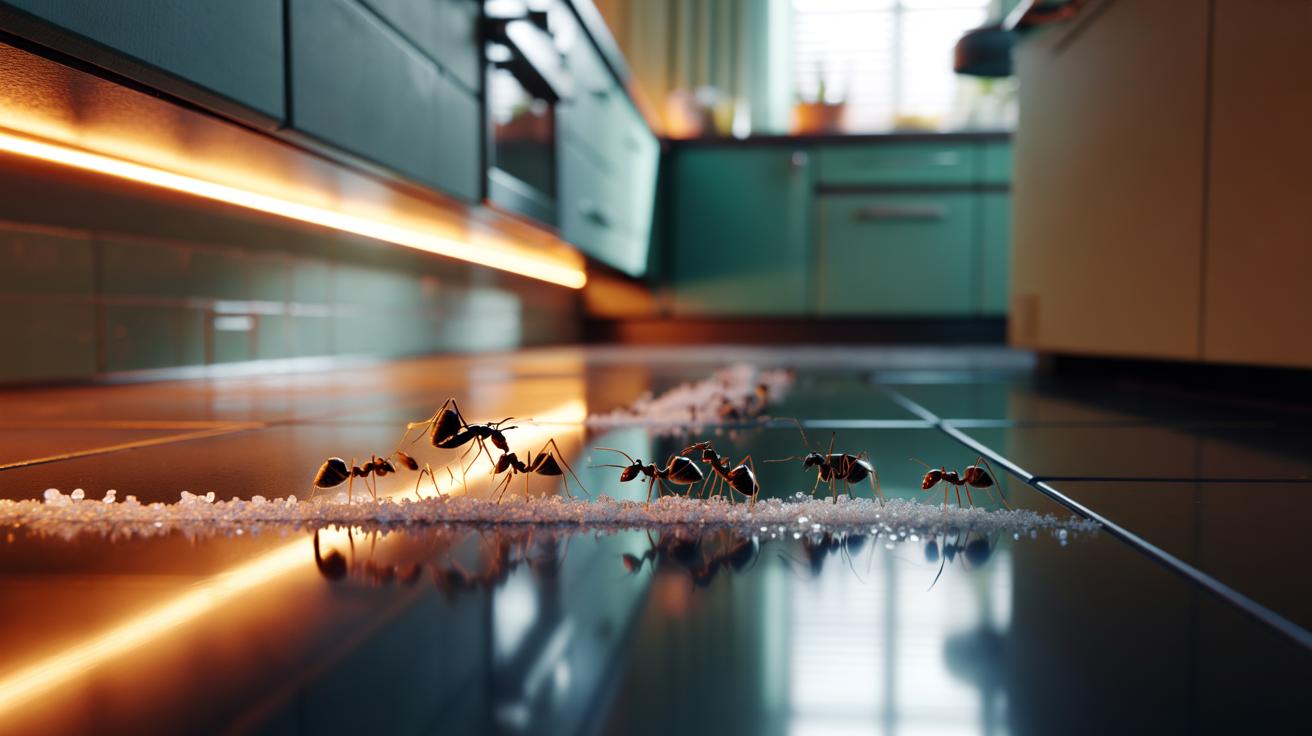
It sounds like folklore: sprinkle a line of salt and ants simply stop. Yet in British kitchens from terraced homes to city flats, the trick often works because minerals create physical and chemical barriers that ants would rather not cross. The crystals pull moisture, scuff cuticles, and scramble the scent highways that guide foragers to crumbs. In a country where damp corners, warm appliances, and summer heat waves collide, a humble shaker can become a household tool. Think of a salt line as an invisible border that reframes the room for an ant. It’s not magic. It’s geology meeting insect physiology.
Why Ants Avoid Salt Lines
Ants navigate kitchens using pheromone trails, a shared map painted in scent. Salt interferes with that map in three overlapping ways. First, crystals are hygroscopic, attracting moisture from air and surfaces. That creates a local zone of dryness that stresses an ant’s waxy cuticle and delicate spiracles. Second, sharp-edged grains act as micro-abrasives. They don’t slice, but they scuff, increasing water loss and discomfort. Third, sodium and chloride ions can alter the microclimate on the floor—changing humidity at the millimetre scale—making the proverbial “road” smell broken.
Laboratory work shows that ants confronted with ionic or desiccating substrates increase detouring behaviour, hesitate, and sometimes abandon a foraging line altogether. In homes, that translates into a pause long enough for you to clean the attractant and seal the entry crack. Species matter: Lasius niger, the common UK black garden ant, tends to avoid dry, crystalline borders more than moisture-loving species. Crucially, a continuous band is more reliable than scattered crystals. The line presents a uniform signal: no easy footholds, a consistent desiccation zone, and a disruptive smellscape that confuses the lead scouts.
Laying Mineral Borders in Real Kitchens
Target the pathways, not the entire floor. Dust a thin, even line where skirting meets tiles, along kickboards beneath cabinets, behind the bin, at door thresholds, and around pipe penetrations under the sink. Use a pinch, not a dune. You’re creating a sensory tripwire, not a beach. In older UK homes, floorboards and gaps near radiators are common entry points, as are silicone seams around washing machines. Never lay salt directly onto wet surfaces; it liquefies, spreads, and can stain or corrode metal feet on appliances.
Which mineral? Fine table salt (NaCl) forms tighter lines that stick to micro-texture. Coarse rock salt holds longer in dry corners but leaves gaps on uneven grout. Baking soda adds mild desiccation and is food-safe, useful near pet bowls, while diatomaceous earth—not a salt, but a silica mineral—provides stronger mechanical deterrence where children and pets won’t disturb it. Epsom salt is less effective for ants, though it can still pull moisture. Reapply after mopping or humid spells. Do not mix salt with bleach or acidic cleaners; clean first, let dry, then chalk your line.
| Mineral | Primary Mechanism | Best Use | Pet/Surface Cautions | Reapply Frequency |
|---|---|---|---|---|
| Table salt (NaCl) | Desiccation, trail disruption | Edges of worktops, kickboards | Can corrode steel over time | Every 2–4 days or after cleaning |
| Rock salt | Desiccation, physical barrier | Door thresholds, garages | Coarse grains leave gaps; slip risk | Weekly in dry areas |
| Baking soda | Mild desiccant, odour masking | Near pet bowls and bins | Generally safe; vacuum before mopping | Every 3–5 days |
| Diatomaceous earth | Micro-abrasion | Behind appliances, under cabinets | Use food-grade; avoid inhalation | Biweekly if undisturbed |
| Epsom salt | Moisture draw | Supplement in dry corners | Dissolves fast in humidity | Every 1–3 days |
The Science of Pheromone Highways and Disruption
Ants lay pheromone highways with tiny droplets from their glands, renewing the route every successful trip. The signal strength and humidity along the trail dictate how confidently followers march. Salt upsets these feedback loops. By absorbing water, crystals lower local relative humidity. That weakens evaporation dynamics ants use to gauge direction and makes the scent fade or fragment. In some species, ionic residues appear to alter the ants’ antennal scanning patterns, lengthening pauses and increasing U‑turns, a classic sign of trail ambiguity.
There is also social psychology at play. Foraging ants are conservative. They prefer the path that smells most certain. When a mineral border forces detours, early recruits arrive late, and fewer reinforcements commit. The colony’s internal calculus reassigns workers to richer, clearer lines. In field observations, a salt band didn’t “repel” every individual; instead, it reduced traffic below a threshold where a kitchen crumb stopped being worth the risk. Lower traffic buys you time to remove food cues and seal the gap. Without reward, the pheromone highway is abandoned, and the map in their tiny heads is rewritten.
Limits, Safety, and Ethical Control
Salt lines are not a silver bullet. High humidity dissolves them. Greasy films neutralise edges. Heavy infestations may simply bridge the border with bodies and debris. Use salt as part of an integrated approach: wipe sugars and oils, empty the caddy nightly, fix drips under the sink, and seal 3–5 mm gaps with silicone or sealant. Where lines meet appliances, watch for corrosion on bare steel and avoid sprinkling near sockets. Pets can experience paw irritation on coarse crystals; vacuum spent lines before playtime. If you share a home with toddlers, keep loose minerals out of reach.
There’s an ethical angle too. Ants are ecosystem engineers outdoors, so aim to deter, not destroy. Reserve baits for persistent colonies that access food stores or pose hygiene risks, and prefer enclosed, targeted stations. If your flat backs onto a communal garden, speak with neighbours: shared habits, not heroic sprinkling, win the day. In rental kitchens, photograph entry points and log dates; a paper trail helps landlords authorise minor sealing works. And remember the British weather: a July heat spike plus open windows equals scouts on the march. Anticipate the season, chalk your mineral borders early, and starve the trail before it blooms.
A line of salt won’t rid the world of ants, but it can redraw the map of your kitchen long enough for smarter fixes. In the delicate choreography between scent, humidity, and habit, minerals tip the balance toward you. Keep the line thin, the surfaces dry, and the food odour-free. Be patient; colonies reassign effort when routes pay poorly. The small ritual of refreshing a border can reset a summer of scouting. As the seasons turn and the rain returns, what invisible borders will you sketch next to keep your home calm, clean, and ant-free?
Did you like it?4.6/5 (26)