In a nutshell
- 🧂 Salt triggers a density shift and strong osmotic pull, forming brine that disrupts hydrogen bonding and reverses capillarity, drawing moisture out of the finish fast.
- 🔍 Diagnose first: white rings live in the finish and respond to salt; grey rings may need heat/reflow; dark/black stains are in the wood and require bleaching or refinishing.
- 🛠️ Method that works: blot, apply dry salt, cover with tissue 2–3 minutes, add gentle heat if needed; for stubborn marks, use a light salt + mineral oil paste, then wipe, buff, and re-wax.
- ⚠️ Mind the finish: high-gloss lacquer, French-polished shellac, and thin wax films scratch easily—test discreetly, use feather-light pressure, and avoid vinegar/alcohol on unknown coatings.
- 📊 Choose wisely: use the article’s comparison cues; when salt fails, reach for petroleum jelly, controlled heat, or wood-safe bleaches like oxalic acid/peroxide, escalating slowly to protect the surface.
There is a kitchen-cupboard remedy that seems almost too neat for the mess it fixes: a pinch of salt scattered on a fresh water ring, a minute of patience, and the pale halo fades from the tabletop. It feels like sleight of hand. Yet behind the quick trick sits hard physics, chemistry, and the way furniture finishes trap and release moisture. Salt doesn’t just soak things up; it shifts the way water behaves at the surface. In homes across Britain, from battered pine breakfast tables to polished walnut sideboards, this tiny crystalline intervention is rewriting the fate of a careless mug.
The Physics Behind Salt’s Instant Response
To grasp why salt appears to “defy” water stains, start with what those marks are. The classic white ring is not a dye; it’s entrained moisture within or just beneath the furniture’s finish, scattering light and turning the surface milky. These rings form as warm, wet cups drive vapour into microvoids in varnish, shellac, or lacquer. Dark stains are different: they signal deep penetration into wood fibres, often reacting with tannins or iron, and are slower, tougher, sometimes permanent without chemical bleaching or refinishing.
Salt changes the local game instantly. As crystals touch the damp patch, they begin to dissolve, creating a brine with higher density and ionic strength than the trapped water. That shift disrupts hydrogen bonding and lowers water activity, establishing a steep osmotic gradient across the finish’s micro-porous network. The result is a directional pull: moisture migrates toward the salt, not deeper into the finish. At the same time, the crystals provide microscopic asperities that gently break surface tension, opening tiny pathways for vapour escape without gouging the coating.
Because most white rings sit within the top millimetre of finish, small changes in capillary pressure matter. The brine’s higher density subtly rebalances capillary forces at pore entrances, tipping the equilibrium toward outward movement. Combined with a warm room or a breath of gentle heat, this becomes a rapid dry-out mechanism. Salt is not magic; it’s a fast, localised engine for moisture reversal. Crucially, it acts where the problem lives: in the finish layer, not in the wood itself.
From Kitchen Hack to Workshop Method
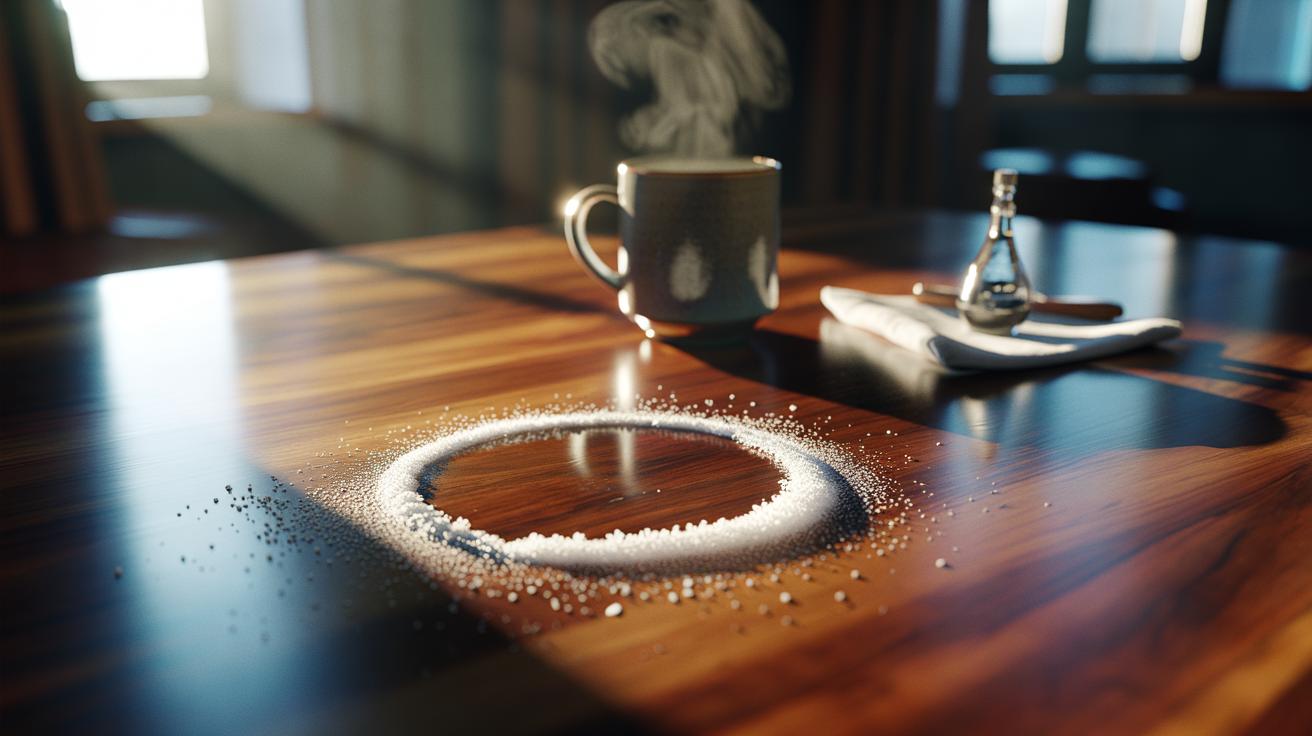
You can make this newsroom-friendly anecdote into a repeatable technique. First, blot the area. No rubbing yet. Place a ring of dry salt directly over the pale halo and lay a single layer of plain tissue or a clean microfibre cloth on top. Leave for two to three minutes. The tissue wicks, the salt densifies, and moisture begins to climb. If the ring lightens, you are extracting vapour from the finish, not abrading the surface. If it doesn’t, add a whisper of warmth: a hairdryer on low, held at a distance, moving constantly.
For stubborn rings, make a mild paste: a half-teaspoon of salt with a few drops of mineral oil (or light cooking oil in a pinch). The oil lubricates, reducing scratch risk, while salt keeps the osmotic pump running and offers micro-polishing. Work with the grain using only fingertip pressure for 30–60 seconds, then wipe clean and assess under raking light. Repeat once if needed. Avoid vinegar or high-proof alcohols on unknown finishes; they can etch shellac or dull lacquer faster than you can say “weekend regret.”
For heat-released finishes (notably shellac and some lacquers), a warm iron through brown paper can drive out moisture, but it’s riskier. Start with salt; escalate slowly. Less force, more control, and constant inspection win this battle. Finish by buffing with a soft cloth and, if appropriate, a drop of furniture wax to re-establish sheen and slip. If the ring turns grey or spreads, stop: you may be dealing with a deeper ingress that demands a different playbook.
Cautions, Finishes, and When to Stop
Not all finishes welcome grit, even gentle grit. High-gloss lacquer, French-polished shellac, and thin wax films can scratch with overzealous rubbing. Test in an inconspicuous corner. If a cotton bud rubbed with oil and salt picks up colour, you might be abrading a tinted topcoat or glaze. Salt excels on bright white rings living in the finish; it struggles on black, tannin-driven stains inside the wood. Those often require oxalic acid, peroxide systems, or a refinish—territory for the patient and well-ventilated.
Use this quick comparison to decide your next move before you make things worse.
| Stain Type | Layer Affected | Salt Effective? | Better Alternatives |
|---|---|---|---|
| White ring (milky halo) | Finish layer (surface moisture) | Yes, often rapid | Gentle heat, petroleum jelly, low-cut polish |
| Grey ring | Deeper in finish | Sometimes | Heat-and-paper, reflow with alcohol (shellac only) |
| Dark/black spot | Wood fibres/tannins | No | Oxalic acid, peroxide bleach, refinish |
| Oily mark | Surface contamination | Limited | Detergent, naphtha test, re-wax |
One last caution: micro-scratching telegraphs under raking light. Keep pressure feather-light and time short. Refresh a waxed surface after treatment to restore glide and mask faint micro-marring. If you feel grit biting, stop; the cure is starting to mark the patient. And remember, on century-old polish, the safest move is sometimes none at all until a professional assesses the finish chemistry.
Salt’s party trick is really a primer in physics: alter density, drive osmosis, reverse capillarity, and water rings retreat. The trick thrives on speed and subtlety, not force. Your table regains its poise, your cup earns a coaster, and your curiosity—rightly—lives on. Next time a pale halo blooms, will you reach for the shaker, the hairdryer, or a different tactic tailored to the finish under your fingertips—and what will you notice about how fast each approach moves the moisture line?
Did you like it?4.6/5 (22)