In a nutshell
- 🔬 Fog forms when warm, moist air hits a cool lens and reaches the dew point; the chemical-free fix is to gently warm lenses and remove residue so droplets can’t form.
- ✨ The Thermo‑Prime method: warm rinse (8–12 sec/side), quick shake, then a thorough microfibre buff (15–30 sec) to leave lenses clean, slightly warm, and resistant to fog.
- ⏱️ Results are fast and practical—clarity typically lasts several minutes and the whole routine takes under a minute, ideal for steamy kitchens, gyms, or winter commutes.
- ⚠️ Safety matters: avoid hot water to protect anti‑reflective (AR) coatings, use a clean microfibre (no fabric softener), and beware hard water spots that act as nucleation sites.
- 😷 Real-world tips: improve airflow control (seal mask nose wires, angle exhalation downward) to extend effect—remember, physics sets limits, but “warm–clean–dry” wins you valuable clear time.
Fogged lenses are a universal frustration, whether you are stepping from cold street to warm café, stirring a simmering pot, or simply exhaling behind a snug mask. The good news: you can banish the mist in seconds without sprays, soaps, or fancy coatings. The method is simple, repeatable, and rooted in basic physics rather than gimmicks. Once you learn the routine, you can prime your lenses on the go and keep them clear long enough to get on with your day. Below, I explain the science of fogging, the precise steps for a chemical‑free defog, and the limits to expect in real life.
Why Glasses Fog in the First Place
Fog is condensation, not dirt. When warm, moist air meets a cool lens surface, water vapour hits the dew point and forms microscopic droplets. Those droplets scatter light and create the milky veil you know too well. The trick to stopping fog is either warming the lens above that dew point or changing how water behaves on the surface. Anti‑fog sprays use surfactants to make a thin film so droplets merge into a clear sheet—effective but chemical. We can achieve a similar outcome by manipulating heat and cleanliness.
Small scratches, grease, or dust act as nucleation sites that help droplets form and cling. That is why a neglected pair fogs faster. A clean, smooth surface resists bead formation and clears quicker when it does occur. Your aim is twofold: remove those micro‑anchors and temporarily raise the lens temperature a whisker above the ambient moist air. Done right, you earn several minutes of clarity—often long enough for your environment or body heat to keep the momentum.
Think of it as preheating a windscreen: a few seconds of preparation saves constant wiping later. With that principle in mind, the chemical‑free approach suddenly feels less like a hack and more like common sense.
The Thermo-Prime Trick: Instant, Chemical-Free Defogging
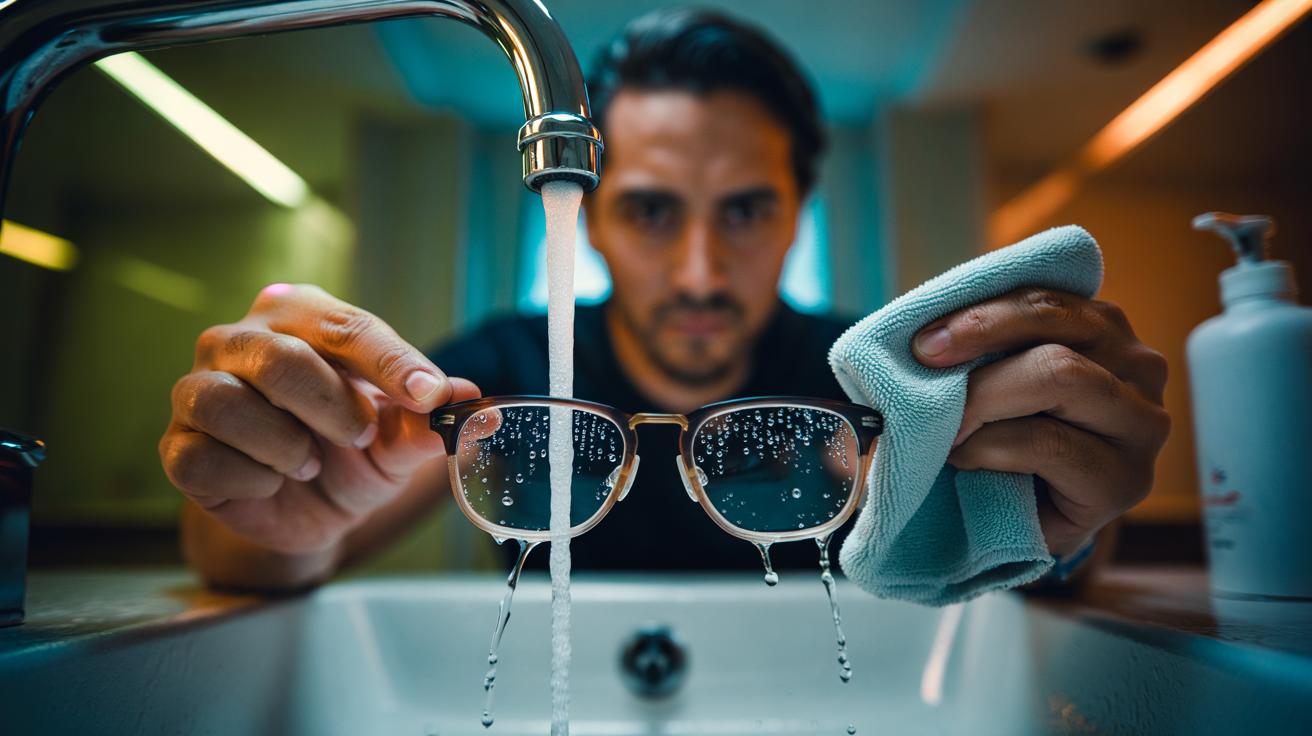
Here’s the “magic”: a quick Thermo‑Prime sequence using only warm water and a clean microfibre cloth. You rinse to remove dust and oils, then briefly warm the lenses, and finally buff them bone‑dry to a smooth, slightly warmed finish. This two‑part effect—clean and warm—dramatically reduces condensation and makes any moisture that does land spread thinly instead of fogging.
Why it works is no mystery. Warm water brings the lens surface a touch above the surrounding air’s dew point, buying you a clear window as you move into steamy or crowded spaces. The meticulous dry buff removes residue that would otherwise seed droplets, so the lens stays optically transparent even as humidity fluctuates. For most people, the clarity lasts several minutes; in milder humidity, it can hold for considerably longer.
There are no soaps, foams, or sprays—just temperature management and surface prep. Done carefully, it’s safe for standard plastics and modern coated lenses. The only caveats are obvious: avoid very hot water and use a proper microfibre (not your jumper) to prevent micro‑scratches that paradoxically make fogging worse next time.
Step-By-Step Guide and Timing
1) Rinse. Hold your glasses under comfortably warm running water—about 40–45°C—for 8–12 seconds per side. This lifts dust and warms the lens evenly. If you can’t access a tap, splash from a clean bottle, then gently swish. Do not use hot water; it can stress coatings and frames.
2) Shake. Flick off excess droplets. The lens should be wet but not streaming. This prevents streaks and speeds drying.
3) Buff dry. Using a clean, dry microfibre cloth, polish both sides with light circular strokes for 15–30 seconds. Keep moving to fresh parts of the cloth so you’re absorbing, not smearing. The lens should feel squeaky‑clean and slightly warm to the touch.
4) Deploy. Put the glasses on and breathe normally. You should see an immediate difference. In heavy humidity (kitchens, gyms, packed trains), repeat when clarity falls off; the full routine takes well under a minute. For mask wearers, seat the nose bridge wire firmly and angle exhalation downward to extend the effect.
| Step | Duration | Purpose |
|---|---|---|
| Warm Rinse | 8–12 sec/side | Raise lens temperature; remove dust/oils |
| Shake | 3–5 sec | Reduce droplets for streak‑free drying |
| Microfibre Buff | 15–30 sec | Smooth surface; eliminate nucleation sites |
Safety, Caveats, and Real-World Limits
Common sense rules apply. Never use very hot water; extreme heat can damage anti‑reflective (AR) layers, warp acetate frames, or weaken adhesives in some rimless mounts. Stick to warm-but-comfortable temperatures, and if in doubt, test with the back of your hand. If your area has hard water, finish with a distilled‑water splash or a meticulous dry buff to avoid mineral spots that invite future fogging.
Keep a dedicated microfibre clean. Wash it regularly without fabric softener, which leaves a film that defeats the purpose. Avoid paper towels or clothing hems; they scratch. If lenses are heavily soiled, do a neutral water clean first. Never rub grit into the surface. Most modern coatings tolerate this routine well, but if your optician warns of a particularly delicate finish, shorten the rinse and extend the gentle buff instead.
There are limits. Step into a sauna or an ultra‑humid kitchen pass and you may still see mist—physics wins. Thermo‑Prime buys you time, not invincibility. Improve odds by controlling airflow: seal mask nose wires, tuck upper mask edges beneath the frame, or angle lenses slightly off the direct path of your breath. For winter commuters, repeat the routine after long outdoor stints; once indoors, your body heat usually takes over and maintains the clarity.
In a world saturated with sprays and foams, it’s oddly satisfying that a sink, a cloth, and a minute of care can outsmart fog. The Thermo‑Prime trick blends physics with practicality, delivers consistent clarity, and protects your lenses from the residue build‑up that chemical fixes can leave behind. Warm, clean, dry: that’s the winning sequence. Ready to try it on your next misty morning, crowded commute, or steamy cooking session—and to see how long your glasses stay clear in your own routine? What tweaks will you make to adapt the method to your daily life?
Did you like it?4.6/5 (27)