In a nutshell
- 🌾 The rice hack delivers a mild, short-lived drop in pH within the rhizosphere, shifting nutrient availability for hours to days while bulk soil remains buffered by cation exchange.
- ⚗️ Temporary acidification and microbial activity chelate micronutrients, unlocking iron (Fe), manganese (Mn), and improving phosphorus (P) access; keep roots within preferred pH bands to avoid Al/Mn toxicity.
- 🧪 Practical use: dilute fresh rinse 1:1–1:3, fermented rice water 1:10; apply at the dripline (100–200 ml per small pot or 1–2 L/m²), test with pH strips, avoid flooding, and space applications 10–14 days.
- 🚫 Limits and risks: it won’t neutralise calcareous soils (~8.2 pH), and overuse invites odour, mould, and root stress; containers react more due to lower buffering, and rice water contributes minimal nitrogen.
- 🧰 Pair with fundamentals: use elemental sulfur to lower pH or dolomitic lime to raise it, boost CEC with compost, consider gypsum for calcium without pH shifts, and flush salts in containers.
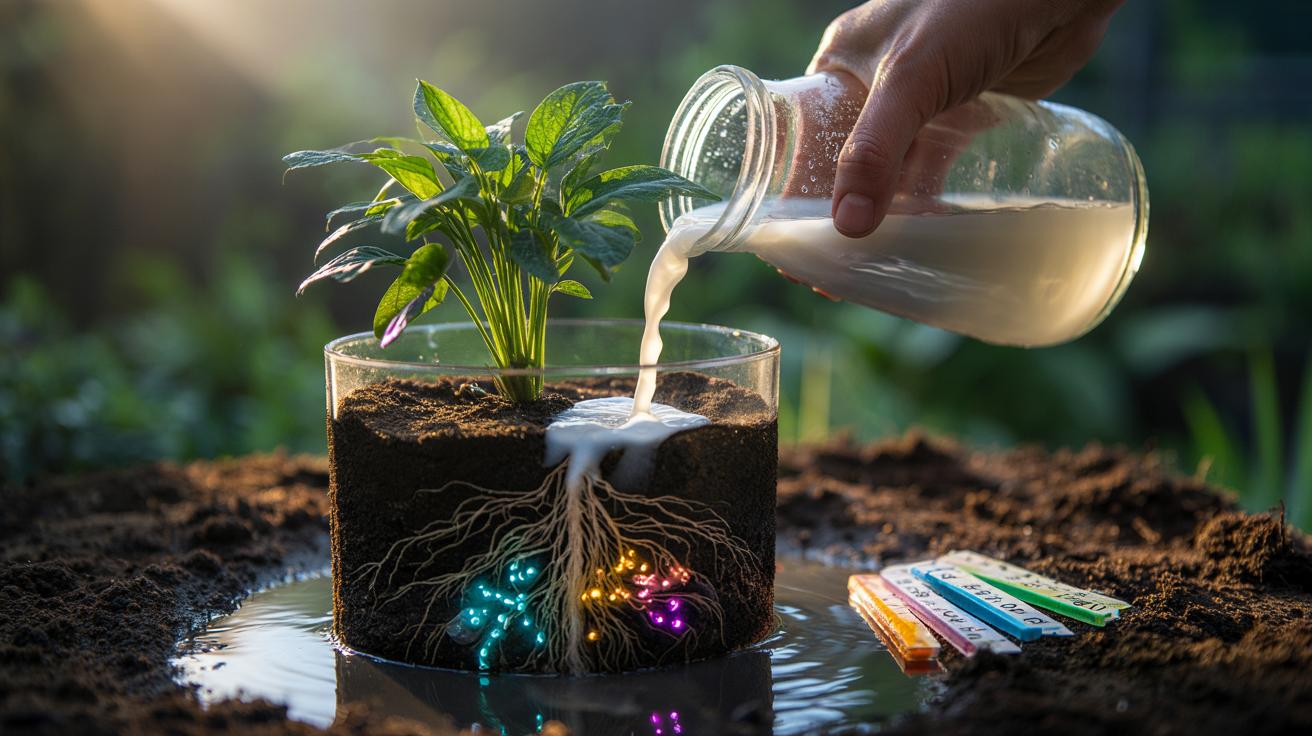
Garden folklore has a new darling: the so‑called rice hack. A splash of rice rinse water, devotees say, and stubborn soils suddenly “behave,” unlocking nutrients and perking up roots. There is a grain of truth. But there’s also chemistry. Rice water carries mild acidity, trace nutrients, and a carbohydrate pulse that rouses microbes. That cocktail can nudge the rhizosphere—the few millimetres of soil hugging roots—fast. The trick is not magic; it’s a brief, local pH shift that alters nutrient availability right where plants feed. Used well, it’s smart. Used blindly, it can invite odours, mould, and imbalance. Here’s how it really works and how to use it safely.
What the Rice Hack Really Does to pH
Rice rinse water is typically slightly acidic (often near 6–6.5), while fermented rice water can drop far lower as lactic acid bacteria multiply. When applied to soil, that acidity, plus dissolved organic compounds, can transiently lower pH in the rhizosphere. Microbes feast on the starches, respiring carbon dioxide that forms carbonic acid in pore water—a fast, soft push toward acidity. That “instant” effect is usually modest and short-lived, measured in hours to days, not weeks. The bulk soil pH barely budges because minerals and clay surfaces buffer change through cation exchange and bicarbonate systems.
Why does it still feel transformative? Because root nutrient uptake is pH-sensitive. A temporary shift can free up iron (Fe) and manganese (Mn), improve phosphorus (P) solubility in mildly acidic conditions, and ease carbonate lock-up in alkaline mixes. In containers with low buffering capacity, the effect appears stronger. But there are limits: if your soil sits at 8.2 due to free lime, rice water won’t rewrite geology. For lasting correction, you need amendments that change the buffering baseline—elemental sulfur to acidify or dolomitic lime to raise pH—guided by a proper soil test.
Nutrients, Ion Balance, and Root Health
Roots live by electrochemistry. Plants absorb nutrients as ions, and uptake is governed by charge balance as much as abundance. When pH dips, H+ ions crowd exchange sites on clay and organic matter, displacing calcium, magnesium, and potassium into solution. That can look like a nutrient “release.” At the same time, microbial activity from the rice-water carbohydrate pulse generates organic acids that chelate iron and zinc, keeping them soluble near roots. This is why a mild, temporary acidification can sharpen leaf colour and revive chlorotic growth.
However, the balance cuts both ways. Drop pH too far and aluminium and manganese can become overly soluble, stressing sensitive species. Push alkalinity and you tie up iron and phosphorus. Healthy roots prefer a steady band—roughly pH 5.5–6.5 for berries and most ornamentals, and 6.0–7.0 for many vegetables. Nutrient form matters too: nitrate uptake tends to raise rhizosphere pH; ammonium tends to lower it. Rice water adds little nitrogen but fuels microbes that tilt the system acidic. Layering that with your fertiliser regime can create harmony—or conflict. The goal is direct balance: pH tuned so nutrients remain available without toxicity, and roots can regulate ion flux without stress.
Using Rice Water and Hulls Responsibly
Use the hack with intent. For fresh rice water, swill the first rinse down the sink to remove dust, then collect the second rinse. Dilute 1:1 to 1:3 with clean water. Apply around the dripline, not on leaves, at a rate of roughly 100–200 ml per small pot or 1–2 litres per square metre of bed. For fermented rice water—sour, yoghurt-scented, pH as low as 3.5—dilute 1:10 and use sparingly. Always test with a pH strip or meter on a small patch first. In compacted or waterlogged soils, avoid flooding; you’ll drive oxygen out and stress roots. Alternate with plain water and keep intervals of 10–14 days. If odour or mould appears on the surface, pause and aerate the soil.
| Method | Typical pH Effect | Timescale | Key Risks |
|---|---|---|---|
| Fresh rice rinse | Mildly acidifies locally | Hours to 1–2 days | Overwatering, minor mould growth |
| Fermented rice water | Stronger, short-term acid pulse | Hours to a few days | Root burn if undiluted, odour |
| Rice hulls/bran | Slow pH drift; adds silica | Weeks to months | N depletion during decomposition if not balanced |
Pair the hack with fundamentals. For chronic alkalinity, incorporate elemental sulfur or acidifying fertilisers; for acid soils, use lime or wood ash judiciously. Gypsum adds calcium without big pH shifts. Mix in compost to lift cation exchange capacity so swings are buffered. In containers, flush salts monthly. And remember: light, temperature, and watering drive nutrient uptake as much as chemistry. Rice water is a nudge, not a cure-all.
The rice hack works because chemistry and biology meet at the root surface, where quick, small pH nudges can unlock stubborn nutrients and steady plant health. Use it to sharpen availability, not to mask structural soil problems. Measure, observe, adjust. If your leaves green up, keep notes on dilution, timing, and crop. If they don’t, pivot to tested amendments and a soil analysis. Gardening rewards curiosity. Given your own soil, climate, and crops, how will you calibrate this simple trick so it enhances pH and nutrient balance without tipping the system too far?
Did you like it?4.3/5 (24)