In a nutshell
- 🌿 The vinegar mist works by delivering dilute acetic acid that nudges water and media to a plant‑friendly pH 5.8–6.5, dissolving bicarbonates, easing nutrient lockout, and encouraging new root hairs.
- 📏 Use safe dilutions: 0.5–1 tsp/L (5% white vinegar), every 4–6 weeks for most plants; acid lovers can take the upper end. Verify with pH strips and avoid exceeding 1 tsp/L for routine misting.
- 🧪 Apply correctly: mix fresh, use a fine atomiser, pre‑moisten soil, mist above leaves (not blooms), avoid midday sun, and always do a 48‑hour patch test on one leaf before wider use.
- 💧 Especially helpful in hard water areas: reduces chalky leaf and pot rims, restores micronutrient availability, and makes existing fertiliser more effective without heavy interventions.
- 🛡️ Practice restraint: skip mists for 5–7 days after feeding, reduce in winter, target soil in heatwaves, and watch for speckling as a sign to dilute—integrate with occasional flushes and balanced nutrition.
Hard tap water, compacted compost, mineral crusts: for many British plant parents, these are the quiet culprits behind languishing leaves. A vinegar mist—a whisper of acetic acid in water—offers a surprisingly elegant fix. The science is simple but potent. A tiny drop in pH can unlock iron, manganese, and phosphorus, ease bicarbonate build-up, and coax fresh root hairs to explore again. The result is cleaner foliage, brighter greens, and steadier growth. Not a miracle. A nudge. Used correctly, this gentle acid tune‑up can refresh the root zone without the scorch or shock that stronger treatments risk. Here’s how to apply it with precision, not superstition.
Why a Vinegar Mist Works
A household splash of 5% white vinegar is, chemically, dilute acetic acid. In hard‑water regions, calcium and magnesium bicarbonates push water alkaline, which can trigger nutrient lockout. Tiny doses of acid neutralise those bicarbonates, glide the solution toward a plant‑friendly pH 5.8–6.5, and increase the solubility of key ions. Iron that once precipitated becomes available again; chlorosis fades. The mist also helps dissolve light limescale on leaf surfaces and pots, clearing pores and improving gas exchange. Short story: you’re not “feeding with vinegar”. You’re restoring balance so the fertiliser you already use can do its job.
Roots respond to steady chemistry. Mild acidity encourages fresh root hairs, improves cation exchange on peat‑ or coir‑based mixes, and can modestly reduce salt crusts after a heavy feeding cycle. There’s a caveat. Acids are powerful agents, even when diluted. Only a very dilute mix belongs near leaves and roots; stronger solutions are for cleaning kettles, not Calatheas. Overuse may irritate tender foliage, suppress beneficial microbes, and push pH too low. Used sparingly, the effect is restorative—closer to soft rain than to a harsh chemical intervention.
Safe Dilutions and Schedules
Start conservatively: 0.5–1 teaspoon of white vinegar (5%) per 1 litre of water. That typically nudges tap water into the sweet spot without risking foliar burn. For acid‑leaning species (ferns, Calatheas, marantas), aim nearer 1 tsp/L once a month. For neutral lovers (pothos, peace lily), 0.5 tsp/L every 4–6 weeks suffices. Use rainwater or distilled water if available; the adjustment is steadier and kinder. Check with inexpensive pH strips. You’re not chasing a lab number, just avoiding the extremes. Never exceed 1 teaspoon per litre with 5% vinegar for routine misting.
| Plant Type | Dilution (Vinegar:Water) | Target pH | Frequency | Notes |
|---|---|---|---|---|
| Ferns, Calatheas, Marantas | 1 tsp : 1 L | 5.8–6.2 | Every 4 weeks | Prefers slightly acidic media |
| Peace Lily, Pothos, Philodendron | 0.5 tsp : 1 L | 6.0–6.5 | Every 4–6 weeks | Watch for leaf spotting |
| Succulents, Cacti | 0.25 tsp : 1 L | 6.2–6.8 | Seldom, if ever | Prefer dry leaves; mist soil only |
| African Violets, Velvety Leaves | 0.25–0.5 tsp : 1 L | 6.0–6.5 | Infrequent | Patch test; avoid petals |
Tables are a guide, not gospel. Your water hardness, potting mix, and fertiliser regime change the equation. If you live in a hard‑water city, the same dilution may land you at a higher pH than someone on soft water. Measure once, adjust calmly. Avoid vinegar mist for 5–7 days after feeding; acids and fresh fertiliser can be a prickly mix. Hard water users will notice fewer mineral spots on leaves and rims after two or three cycles—evidence that bicarbonates are being tamed.
How to Apply the Mist Without Harm
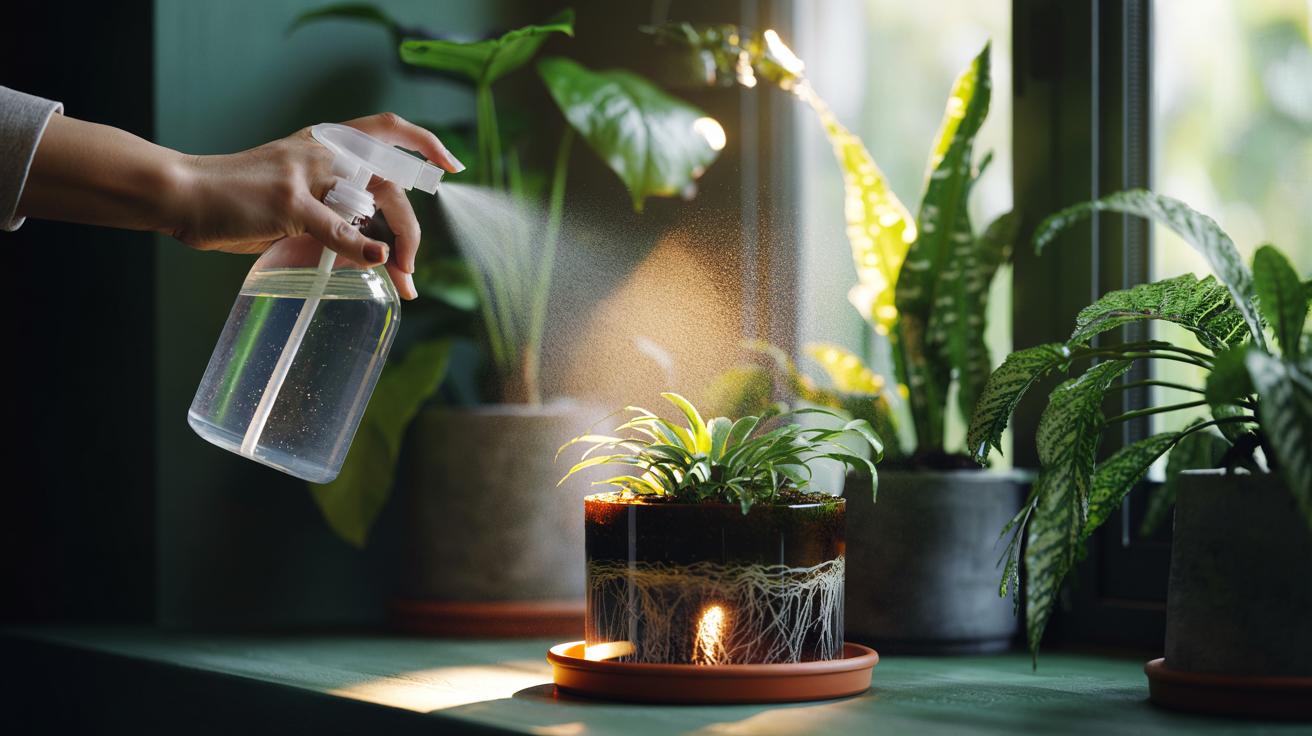
Mix fresh each time; acetic acid weakens and can invite off odours in old solutions. Use a fine atomiser and cool, clean water. Pre‑moisten the compost lightly, then mist the air above foliage and let droplets settle—don’t drench. Avoid open blooms and midday sun. Wipe any residue from windowsills to prevent etching. Indoors, a brief fan cycle helps leaves dry. Do a leaf patch test on one plant, one leaf, and wait 48 hours before rolling it out to the rest.
Look for signals. Tiny tan speckles or a matte film? Too strong—halve the dose. Greener new growth and fewer chalky rims on pots? You’ve hit the mark. Fold the mist into a broader routine: occasional deep flushes to remove salts, balanced fertiliser, and adequate light. In winter, reduce frequency as metabolism dips. In heatwaves, skip foliar application and target the topsoil instead. Done this way, the vinegar mist is not a fad; it’s a small, repeatable correction that keeps the root zone in an agreeable, biologically active range.
The trick is restraint. A measured acid pulse softens hard water’s edge, unlocks micronutrients, and coaxes roots to push outward, not sulk inward. You’re emulating the chemistry of a soft summer shower, not scrubbing leaves with kitchen cleaner. If you stay within gentle dilutions, test occasionally, and watch your plants’ response, the payoff is lush growth without drama. It’s a journalist’s favourite kind of hack: cheap, testable, and quietly transformative. Will you log a month of careful mists—dose, pH, plant notes—and see which of your houseplants glow first?
Did you like it?4.4/5 (30)