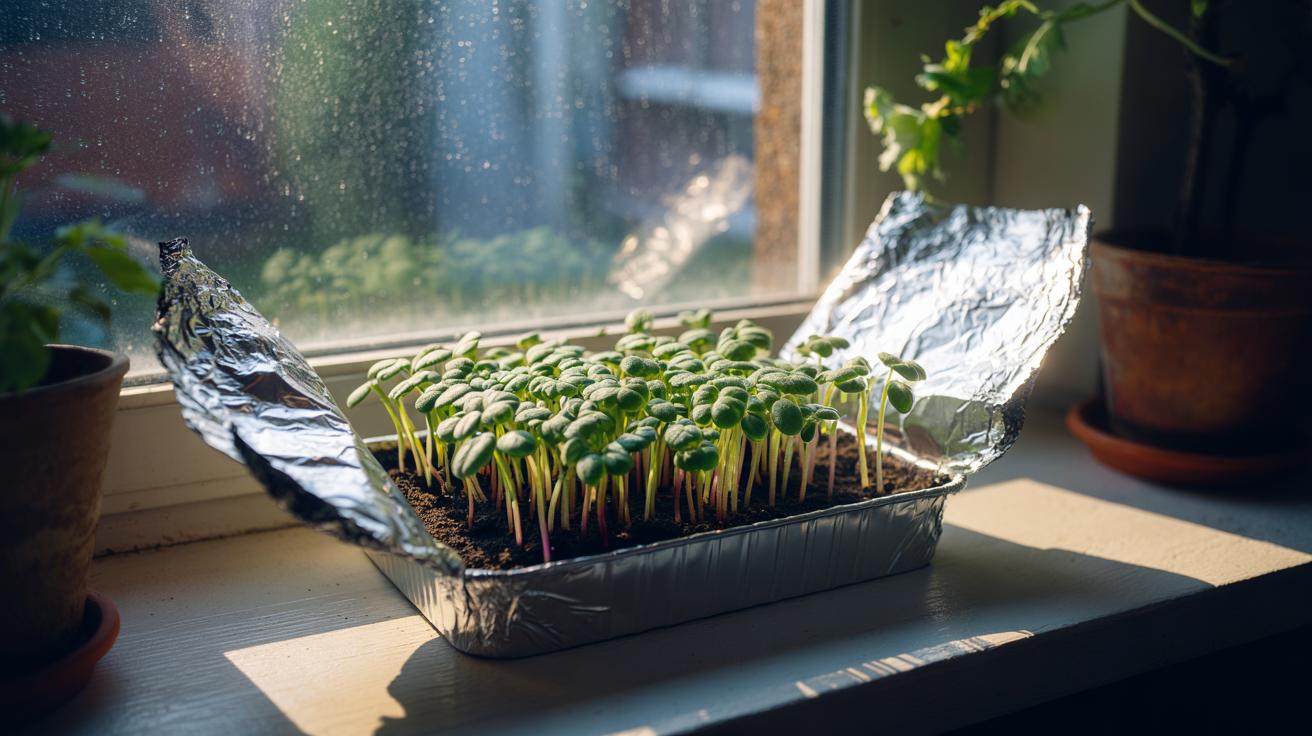
In a nutshell
- 🚀 Rapid growth boost: Wrapping aluminium foil around seed trays reflects otherwise wasted light, raising PPFD and driving photosynthesis for sturdier stems, greener leaves, and tighter internodes.
- 🔁 Even canopy, better signals: Multi‑angle illumination fills shadows and supports photomorphogenesis, while a shifted red:far‑red balance tempers shade-avoidance for compact, well-formed plants.
- 🛠️ Practical setup: Shiny side in, leave the top open for ventilation, angle foil in a shallow “V,” keep 2–5 cm clearance, and monitor moisture and temperature to prevent condensation and hot spots.
- 🪞 Reflector choices: Foil is cheap and directional; white card/paint offers diffuse, even light; Mylar delivers higher reflectance with better diffusion—pick based on glare, budget, and space.
- 🌱 Real-world payoff: In small spaces, this pennies-in hack accelerates true-leaf emergence, deepens chlorophyll colour, and maintains compact architecture; it also reclaims LED side spill efficiently.
On a drizzly British morning, the quickest way to turn a dim windowsill into a seedling powerhouse isn’t another gadget; it’s a roll of kitchen foil. Wrap aluminium foil around seed trays and you’ll bounce otherwise wasted light back into the canopy. That means more usable energy for tiny leaves at the moment they need it most. The effect is visible within days: sturdier stems, greener blades, tighter internodes. By intensifying and evening out illumination, foil reduces the odds of spindly, leggy growth. It’s simple, inexpensive, and elegantly rooted in plant science—especially the way reflected light drives photosynthesis and leaf development.
How Reflected Light Accelerates Seedling Growth
Seedlings live on a fine margin. Every extra photon counts. When you wrap a tray with aluminium foil, the bright side faces inwards and reflects a chunk of incoming daylight back onto cotyledons and the first true leaves. The gain isn’t just intensity; it’s coverage. Reflected light fills dark edges and the shadowed lower surfaces that usually miss out. That reduces directional stress from side-lit sills, encourages even canopies, and cuts the tendency to lean.
Physiologically, more light drives more chlorophyll activity, so sugars accumulate faster. Seedlings channel that energy into cell expansion and new tissues, particularly the lamina. At the same time, a richer mix of angles increases useful blue and red photons reaching all leaf planes, aiding photomorphogenesis—the suite of growth responses shaped by light quality and direction. The result is a broader leaf area, quicker unfolding, and stronger petioles.
There’s also a signalling twist. The reflective surround alters the perceived red:far‑red balance at the leaf surface, tempering the classic shade-avoidance response that triggers elongation without substance. In short, more balanced light equals better architecture rather than mere height. That’s why a simple wrap can tighten internodes while still accelerating growth.
Tin Foil Versus Other Reflective Surfaces
Not all reflectors behave the same. Foil is bright, cheap, and directional: it throws light where you aim it, which is ideal for corralling sunshine on a narrow sill. White card and matt paint are more diffuse; they scatter light softly and evenly, helpful if glare or hot spots are a risk. Specialist films such as Mylar are premium options, offering high reflectance with better diffusion—but at a price. This quick comparison helps you choose what to wrap around your seedlings:
| Material | Approx. Reflectance | Diffusion | Cost | Notes |
|---|---|---|---|---|
| Aluminium foil | ~85–92% | Low–medium (directional) | Very low | Crinkles add mild diffusion; easy to mould |
| White card/paint | ~80–90% | High (soft scatter) | Low | Even light; less risk of hot spots |
| Mylar/emergency blanket | ~90–97% | Medium–high | Medium | Efficient and durable, needs tidy mounting |
For raw speed on a budget, foil wins because it redirects a lot of light with minimal faff. If your windowsill gets harsh midday beams, a white surround can soften delivery and keep temperatures steadier. Whichever you choose, the goal is the same: elevate the PPFD—the photosynthetic light reaching the leaf—without installing extra lamps.
Practical Setup: Wrapping Seed Trays for Maximum Effect
Start with clean, dry trays. Line the inside faces of your propagator walls or the outer rim of the tray with aluminium foil, shiny side in. Leave the top fully open so air moves freely. Do not stretch foil over the seedlings; they need ventilation and a clear exit for rising warmth. Fold edges neatly to avoid sharp corners. If you’re using a heat mat, keep foil away from electrics and controls.
Angle matters. Splay the foil slightly outward like a shallow V so reflected rays spread across the canopy rather than bouncing straight back. On a south-facing sill, put a higher foil “backboard” behind the tray to catch low winter sun; on east or west sills, make two wings to gather morning or evening light. Keep leaves 2–5 cm from the reflective surface to avoid damp pockets and to spread light more evenly.
Water carefully. Reflective wraps can raise local temperatures by a degree or two and slow evaporation at the edges, so check moisture more often but water less. Lift the wrap once a day to refresh air and inspect for condensation. If using LED task lights, angle them from above and slightly forward; the foil will reclaim side spill without dazzling you. Mark sowing rows on the outside with a pen—the wrap doubles as a handy label.
Science in the Seed Tray: Signals That Shape Leaves
Plants read light as information as well as fuel. Phytochromes track the red:far‑red ratio and set shade-avoidance programmes; cryptochromes and phototropins sense blue light, steering stomata, leaf thickness, and orientation. By bouncing light back into the lower canopy, foil raises the effective photon dose while nudging those sensors toward a “not-shaded” message. That encourages lamina expansion, thicker mesophyll, and better chloroplast development, rather than lanky stems reaching for a brighter patch.
Geometry helps. Leaves aren’t flat solar panels; they twist and curl through the day. Multi‑angle illumination reduces self‑shading and keeps photosynthesis ticking across more of the surface. The payoff is efficient carbon gain per gram of plant—faster growth that still looks compact and healthy. In practical terms, you’ll often notice quicker emergence of the second true leaves, tighter spacing between nodes, and a richer green as nitrogen investment in chlorophyll pays off under a brighter, more uniform field of light.
For growers in small spaces, the beauty of a foil wrap is its leverage: pennies in, performance out. It respects the seedling’s biology, harnessing daylight you already have and redirecting it where it matters—across tender leaf surfaces hungry for energy and cues. Keep it tidy, keep it ventilated, and watch the canopy fill in with satisfying speed. Ready to try it on your next sowing, or will you experiment with white card and note the difference in leaf shape and colour across a fortnight?
Did you like it?4.6/5 (22)