In a nutshell
- ⚡ Pattern interruption creates an attention gap that swiftly redirects social proof, letting a new, simple norm become the group’s default.
- 🚶♀️ In public spaces, pairing a jolt (visual, audio, or human) with a clear, copyable cue—like floor markers or a “first follower”—drives rapid, visible shifts in flow.
- 💻 Online, subtle breaks in the scroll combined with credible social proof (real names, local context, honest counters) boost engagement without gimmicks.
- 🧭 Design ethical interventions: reduce harm, keep instructions brief, time signals precisely, and measure outcomes; trust is the asset that compounds.
- ⚠️ Beware reactance and reputational risk from noise or fake proof; use pilots, transparency, and redundancy—influence is rented, consent is owned.
When groups move as one, it feels inevitable. Yet often, a tiny disruption steers the crowd. This is the quiet power of social proof accelerated by pattern interruption. A pause in the routine. A strange sound. A sign that flips the script for just a second. Suddenly, eyes align and behaviour cascades. Interrupting expectation is a shortcut to attention, and attention is the gateway to new norms. In a world of queues, feeds, and fast decisions, those who design the moment of surprise can redirect whole groups swiftly. The question is not whether this works—it’s how to use it responsibly.
The Mechanics of Social Proof and Pattern Interruption
Humans rely on heuristics, especially in uncertain contexts. One of the most powerful is social proof: if others like me do this, it’s probably right. Pattern interruption jolts our automatic scripts—those habits that run without thinking—creating a brief window where new cues dominate. In that gap, the group looks outward for a signal, and the signal often becomes the new rule.
Think of attention as a scarce currency. A disruption—visual contrast, an unusual sound, an unexpected human action—buys a few seconds of heightened salience. During those seconds, a clear, easy-to-copy behaviour can propagate fast: a single person stands to clap; others follow; the ovation becomes inevitable. Neuroscience studies point to predictive coding: when expectations are violated, the brain updates models rapidly, giving priority to salient social cues.
Speed matters. The shorter the interval between interruption and the presentation of a compelling norm, the stronger the effect. That’s why interventions pair a jolt with a simple directive or a salient exemplar. Make the alternative obvious, visible, and low effort, and the crowd will do the rest.
Rapid Crowd Shifts: From Pavements to Platforms
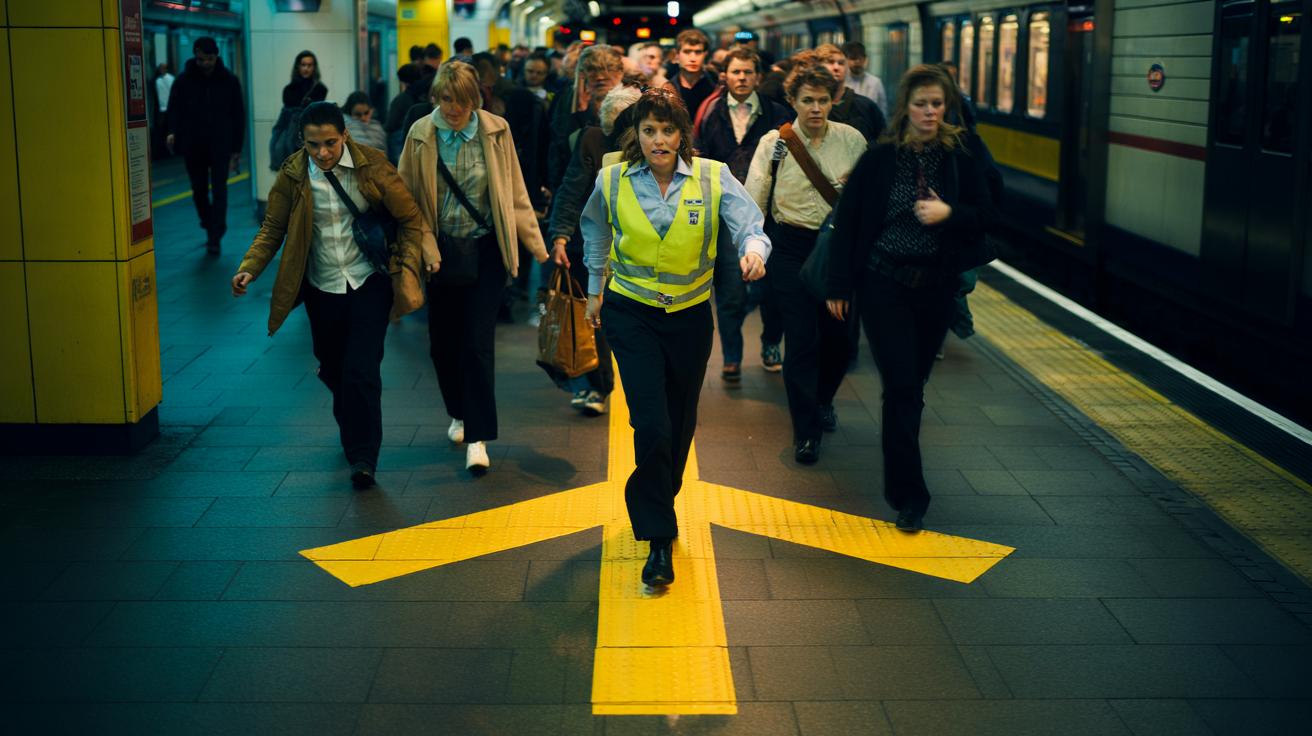
On a London platform, one commuter switches queues after a staff member rolls out a bright floor marker. Within a minute, dozens pivot. The cause isn’t authority alone. It’s the interruption—the sudden appearance of colour and motion—plus a highly legible new pattern. Norms need a stage. Pattern interruption builds it in real time.
Street crossings tell a similar story. A novelty audio cue at a junction—say, a different tone or a playful message—makes heads turn. Then a visible lead crosser moves. The rest follow, safely or not, depending on the norm set. At a football ground, a chant begins off-beat, unusual enough to hook attention, then regularises into a rhythm thousands can copy. Oddity opens the door; repeatability invites the crowd in.
Digital spaces compress the timeline further. A looping product video pauses at an unexpected frame; a testimonial slides into view with a striking contrast colour; a live counter ticks up. Engagement spikes because the scroll is broken, and the new anchor is social: ratings, shares, visible purchases. The swiftest shifts occur where the interruption is immediately paired with credible cues—real names, local context, or time-stamps that feel authentic.
Designing Ethical Interventions in Public Spaces
If you plan to steer behaviour—safer queuing, cleaner recycling, calmer boarding—start with intent. Interruption should reduce harm and increase clarity, not manipulate. The craft is to introduce a brief surprise, then land a simple, pro-social action. High-contrast footprints on station floors. A sudden, polite audio chime followed by a five-word instruction. A volunteer demonstrator who models the movement decisively. The throughline: clear, copyable, context-aware.
Choose materials that read at a glance and avoid cognitive overload. In crowded environments, use one cue at a time and place it where eyes already go—at bottlenecks, decision points, or where flow falters. Consider timing as much as design; the first 10 seconds of a disruption are precious, and your norm signal must arrive instantly.
| Intervention | Interruption Used | Typical Outcome |
|---|---|---|
| Floor decals at entrances | Visual contrast + repositioning | Queues realign within 60–90 seconds |
| Brief audio chime then instruction | Novel sound | Attention spike; compliance with next-step cue |
| Staff “first follower” demo | Unexpected human lead | Rapid imitation; durable new flow |
Measure, iterate, and sunset tactics that confuse or coerce. Trust is the compounding asset; spend it carefully.
Digital Playbooks: Breaking the Scroll to Build Trust
Online, pattern interruption is everywhere, but only some versions nurture credible social proof. A muted product video stops at a freeze-frame showing a real customer using the item in a recognisable British setting. A price card flickers once, then steadies alongside a “Trusted by 12,482 locals” tag. The interruption captures the eye; the proof secures the click.
Micro-interactions can do the heavy lifting. A button subtly changes copy after a hover—“Join” becomes “Join 3,200 Londoners”. A review carousel starts with the outlier—an unusually concise, high-authority testimonial—before rotating to the rest. Live indicators (“Just bought in Manchester”) must be honest and rate-limited; fake urgency backfires, killing believability.
For onboarding, insert a single surprising question early—human, not bureaucratic—then immediately present a peer benchmark. “How do you plan to use this?” followed by a cluster of popular choices. Keep it light. Keep it kind. And always allow opt-out. Agency sustains adoption long after the novelty fades.
When the Shortcut Backfires
Not all interruptions land. If context is misread, you get reactance—a defensive pushback that spreads faster than compliance. Visual noise can feel like nagging. Audio cues can irritate. And when social proof turns out to be flimsy—paid reviews, staged photos—the trust cost is brutal. The quickest route to influence is also the quickest route to reputational damage.
Guardrails help. Use small pilots, transparent messaging, and independent verification where claims are made. In safety-critical settings, pair interruption with redundancy: signs, staff, and physical channeling, not any one element alone. Track sentiment, not just throughput; complaints are data. In digital campaigns, disclose sponsored testimonials and show a distribution of ratings, including the middling ones. Authenticity reads as texture, not gloss.
Above all, tie tactics to outcomes you’re willing to defend in public. If the benefit accrues mainly to you while the friction falls on users, expect attrition. Influence is rented; consent is owned.
Pattern interruption can redirect groups with startling speed, yet its lasting power comes from the quality of the norm it reveals. Design the jolt, yes, but earn the follow-through with clarity, credibility, and care. In stations, on screens, in stadiums, the same rule holds: people copy what feels safe, simple, and socially endorsed. Use the shortcut, but respect the long road of trust. Where might a small, well-timed interruption help your community behave better—without feeling managed?
Did you like it?4.5/5 (20)