In a nutshell
- 🌱 Salt acts fast via osmotic stress, delivering visible wilting in hours to days; it’s a non‑selective, contact solution best reserved for hard surfaces like patios and block‑paving joints.
- ⏱️ “Faster” means surface browning: salt wins the weekend, while systemic herbicides like glyphosate are slower to show but often win the season by reaching roots and rhizomes.
- 🌊 Major risk is residual salinity and runoff; avoid beds and lawns, keep it away from drains and waterways, and note potential corrosion and pet irritation.
- 💷 Economics: salt is cheap and familiar, yet frequent reapplication and possible surface damage can erase savings; councils and gardeners increasingly use a hybrid toolbox (brushes, hot water, limited spot treatments).
- 🧭 Responsible use: target only visible growth, apply lightly, skip before heavy rain, and in food gardens prefer mulch, hoeing, or thermal methods—aligned with UK product and council policies.
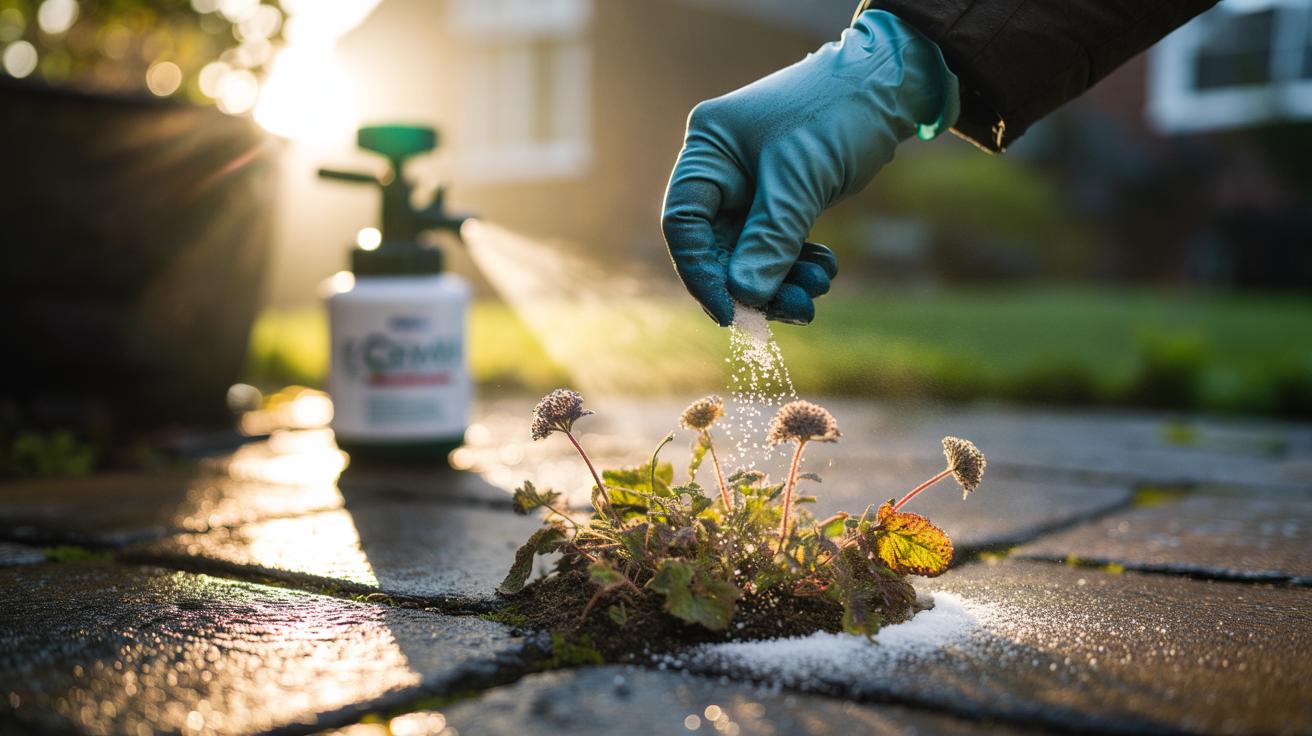
Britain’s pavements and patios are sprouting again, and a new old idea is making waves: ordinary salt as a rapid weed killer. Cash-strapped councils and home gardeners alike are asking whether sodium chloride clears problem growth more swiftly than the usual sprays. The answer is nuanced, yet compelling. Salt bites fast. Chemicals often bide their time. Between speed, cost, and environmental trade-offs lies a story of changing habits, shifting regulations, and practical decisions made on soggy Sunday mornings. Used carelessly, salt is blunt; used precisely, it can be disruptive—in a good way—to rampant weeds. Here’s the science, the speed, and the stakes.
The Science Behind Salt as a Weed Killer
Salt works by inducing osmotic stress. Water moves out of plant cells to balance the salty conditions around roots and leaves, and that rapid dehydration triggers wilting, tissue collapse, and—if exposure is high enough—death. Think of it as accelerated desiccation rather than poisoning. No complex biochemical pathways. No enzyme targets. It’s a simple physical shock to plant water balance, and that simplicity is why salt acts quickly.
There’s a catch: salt is non-selective. It does not discriminate between dandelions and daisies, or between “weeds” and ornamental groundcovers. Salt also interacts with soils. Sodium can displace calcium on clay particles, dispersing aggregates, tightening the soil, and impairing drainage over time. Microbial communities, pivotal to healthy beds, are sensitive to elevated salinity. On porous pavements and gravel drives, those risks drop; on vegetable plots, they rise sharply. Rain redistributes salt downward and sideways. Capillary rise can bring it back up in dry spells. Persistence depends on soil texture and rainfall patterns. The upshot? Salt is best viewed as a fast-acting contact solution for hard surfaces, not a blanket cure for borders or lawns.
Speed Versus Systemic Chemicals: What “Faster” Really Means
Gardeners prize visible results. Salt provides them. You can see leaves slump within hours on soft annuals, and many perennials show browning by day two. By contrast, popular systemic herbicides such as glyphosate must be transported to roots to finish the job, so the top growth may stay deceptively green for a week. That delay frustrates, but it delivers thoroughness, especially on deep-rooted perennials. Contact chemicals (or strong acetic acid formulations) act quickly too, yet regrowth can be brisk. “Faster” is about what you see above ground, not necessarily long-term control.
Here’s a snapshot comparison to demystify the trade-off.
| Method | Onset of Effect | Mode of Action | Longevity | Risk Highlights | Best Use |
|---|---|---|---|---|---|
| Salt (NaCl) | Hours to 2 days | Osmotic desiccation | Short to moderate; roots may reshoot | Soil salinity, runoff to drains | Hard surfaces, spot cracks |
| Glyphosate | 5–10 days visible | Systemic enzyme inhibition | Longer-term on many perennials | Regulatory scrutiny, label limits | Stubborn perennials, bed edges |
| Acetic Acid | 1–2 days | Contact tissue burn | Short; frequent retreatment | Leaf scorch, eye/skin irritation | Young weeds, paths |
In practice, salt can “win the weekend”: a fast clean-up before guests arrive or a quick reset between paver blocks. Systemics often “win the season” by travelling to rhizomes and roots. Many readers will blend tactics—rapid salt spot-work on patios, patient systemic control or mechanical removal for deep-rooted intruders. Seeing browning by Monday is satisfying, but lasting results still rely on choosing the right tool for the right plant.
Environmental Risks and Responsible Use
Salt’s biggest hazard is invisible: residual salinity. Chloride ions don’t vanish; they move. Into borders, onto neighbours’ verges, through drains towards waterways. Elevated chloride can harm amphibians and aquatic invertebrates, while sodium undermines soil structure and plant resilience. That is why expert advice leans conservative. Keep salt off beds and lawns. Avoid applying before heavy rain. Never sweep crystals into gullies. If you wouldn’t pour it into a pond, don’t pour it where the next storm can take it there.
Think surfaces. Patios, block-paving joints, gravel paths—places where roots are shallow and soil biology is minimal—are where salt is least problematic. Use minimal quantities, target only the growth you see, and tolerate a little green as habitat on peripheries. Corrosion matters too: frequent brine on metal edging or stonework can mark and degrade it, and pets may be irritated by residue on paws. For food gardens, prefer mulch, hoeing, or thermal weeding. And consider local rules: in the UK, only authorised products may be sold as herbicides, and public-space use is often governed by council policy. Kitchen cupboard tricks are not a carte blanche for mass application.
Economics, Policy, and the Future of Low-Chemistry Weed Control
Salt is cheap, widely available, and familiar. That trifecta turns heads in a cost-of-living crisis. A bag costs less than a branded herbicide and sits happily in the shed for months. Yet economics is wider than sticker price. Repeated applications, potential paving damage, and time spent redoing missed patches can erase savings. Systemic products, used sparingly and correctly, may mean fewer repeats. Mechanical tools—stiff brushes, flame or hot-foam units used by some UK councils—carry upfront costs but reduce chemical and salt loads alike.
Policy winds are shifting. Several European cities curtail glyphosate on aesthetics or precautionary grounds, and some UK councils are trialling hybrid regimes: hot water on play parks, brushes on kerbs, limited spot treatments elsewhere. Salt enters as a quick-fix component, not a strategy. The emerging consensus is pragmatic: diversify methods, target precisely, and adapt to site conditions. There is no silver bullet; there is a toolbox. Expect guidance to harden around drains and water-sensitive zones, and expect public tolerance for “perfectly sterile” streets to fade as biodiversity goals rise. That cultural change, rather than any single product, will decide what “fast” looks like in five years.
Salt can indeed clear gardens faster than many chemicals—visually, on the surfaces where speed matters most. Yet speed is only one measure. Soil health, wildlife, and long-term control count too. The smart move is selective deployment: hard surfaces, light touch, eyes wide open to runoff and regrowth. In that balance lies a modern, responsible approach to weeds that respects both kerbs and ecosystems. Will your next weed plan chase instant browning, or invest in season-long resilience—and what mix of tools will earn that result on your patch?
Did you like it?4.4/5 (23)