In a nutshell
- 🔬 A tightly crumpled aluminium foil ball disrupts drum motion, injecting turbulence that breaks up fabric clumps, shortens rubbing time, and curbs the triboelectric build-up that causes static.
- ⚡ Aluminium’s high conductivity acts as a roaming charge sink, gently neutralising imbalances on contact—especially useful for polyester-rich loads prone to cling.
- 🌬️ Better airflow and separation make drying more even, reducing hard creases and boosting natural softness without chemical coatings, unlike dryer sheets; wool balls help too but lack the metal’s charge dissipation.
- 🛠️ Practical tips: compress to tennis-ball size, smooth sharp edges, use 1–3 per load, avoid delicates, expect some noise, don’t over-dry, and keep the lint filter clean for consistent results.
- ♻️ Low-cost and reusable, the foil-ball method cuts waste and ongoing spend on dryer sheets while delivering high static control and solid softness benefits.
British laundry rooms have embraced a simple hack: tossing a tight ball of aluminium foil into the tumble dryer. It sounds like folklore, yet the effect is real: clothes emerge less clingy, often noticeably softer, with fewer creases and less lint snarled to sleeves. The explanation lies in the physics of air and charge. Inside a rotating drum, chaotic airflow, rapid contacts, and dry fibres set the stage for static electricity. Add a conductive sphere and the fluid dynamics change. Small changes in turbulence scale into big differences in how fabrics collide and charge. Here’s the science behind the shiny ball’s quiet power.
How Turbulence Tames Static in the Drum
Static in a dryer begins with the triboelectric effect. As cotton, polyester and blends rub and peel apart, electrons transfer between surfaces. In dry air, those charges stick. Repeated contact-separation cycles amplify them until cuffs cling, socks spark and lint leaps. The standard tumble action can be surprisingly orderly: sheets wrap around hoodies, forming damp bundles that scrape, compress and charge with every rotation. The result is predictable: cling and crackle.
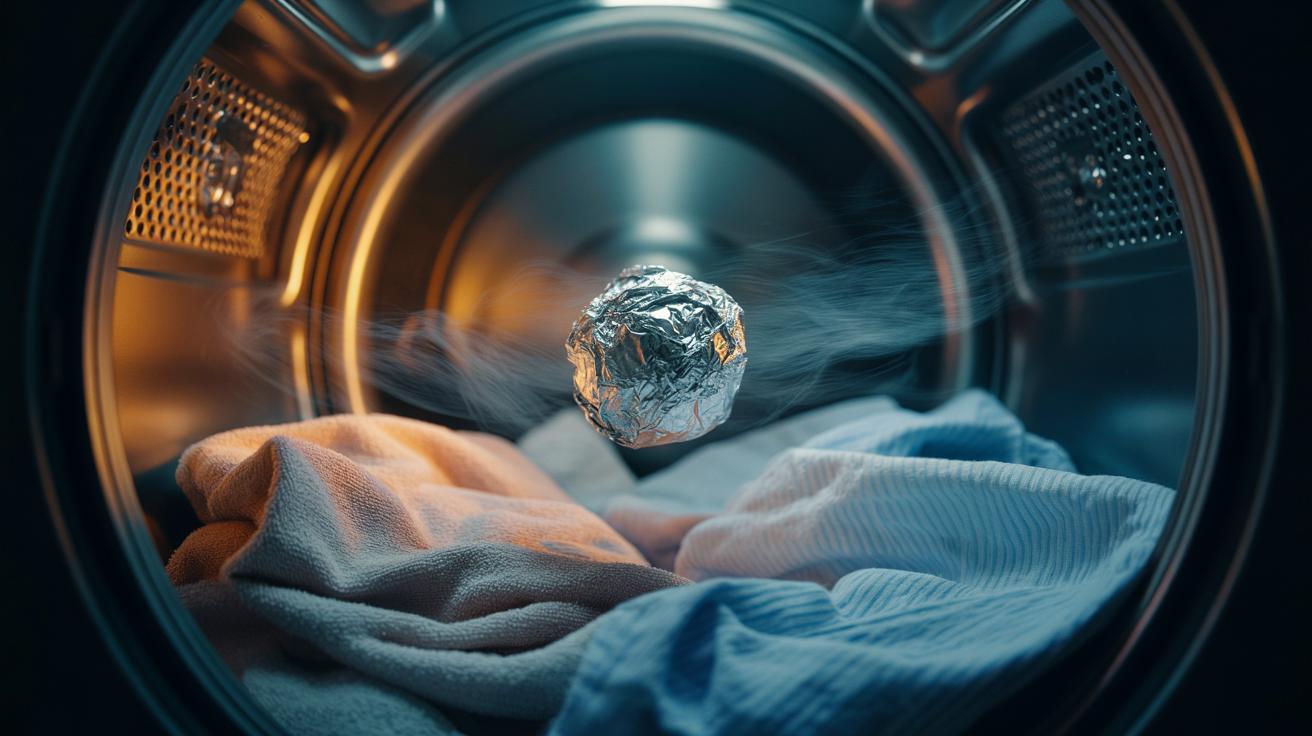
Introduce a compact foil sphere and the motion changes. The ball acts as a mobile baffle, injecting turbulence into the pocket of air around it, breaking up blankets and interrupting long, sliding contacts that load charge. Instead of two fabrics grinding together for seconds at a time, the contact becomes staccato, brief and less energetic. Eddies and micro-vortices puff garments apart, pulling air through layers. Less sustained rubbing equals less charge accumulation. This subtle reshaping of the flow field turns a clumping drum into a mixing chamber where static has fewer chances to bloom.
There’s also the metal itself. Aluminium is highly conductive, so the ball behaves like a roving sink for charge. When charged fabric touches the foil, excess electrons spread across the ball and towards the earthed drum, gently neutralising imbalances. That drainage can be modest, but the combined effect—shorter contacts, better air mixing and a conductive touchpoint—cuts static sharply. Humidity still matters: a slightly damp load reduces charge build-up anyway, and the turbulent separation helps moisture distribute evenly, keeping conditions anti-static for longer.
Why a Foil Ball Boosts Softness Without Chemicals
Softness isn’t just chemistry; it’s mechanics. The “hand” of a garment depends on fibre flexibility, surface friction and the creases set as it dries. Static makes everything worse. Charged fibres collapse together, creating stiff plates that harden into wrinkles. By lowering static cling, a foil ball allows fibres to separate and rebound, so the fabric relaxes instead of locking into sharp folds. The resulting drape feels looser, less crackly, more wearable straight from the dryer.
The sphere also props open the load. It nudges layers apart, promoting airflow through pockets that would otherwise mat together. That encourages even drying. When water leaves at a uniform rate, fibres avoid the overcooked, “brittle” edge that comes from prolonged exposure to hot, dry air. Clothes emerge supple, with fewer hard compression creases and less need for aggressive ironing. Mechanical agitation plus balanced drying beats blasting textiles until they surrender. And because the ball adds only minimal mass, it lifts and drops fabrics without pummelling them.
Compare this with dryer sheets, which mask roughness by depositing lubricants and perfumes. A foil ball doesn’t coat anything. It uses turbulence and conductivity to change the drying environment itself, making it attractive for those with fragrance sensitivities or who want to avoid residues on towels and athletic wear. Wool or rubber dryer balls offer similar separation benefits, but the metallic option quietly excels at dissipating charge, especially on polyester-rich loads where static is most stubborn.
Practical Guide: Size, Safety, and Cost Compared
Make one in a minute. Crumple two to three sheets of heavy-duty aluminium foil, then compact them tightly until you reach roughly tennis-ball size. Smooth the exterior so there are no sharp ridges. For small dryers, one ball often suffices; larger mixed loads benefit from two or three to maintain separation across the drum. Expect months of use: when the ball becomes loose or shreds at the surface, re-crush or replace. It costs pennies and stores neatly with the pegs.
Is it safe? In a modern, earthed dryer, yes. The foil won’t melt at laundry temperatures, and it won’t spark if the drum and bearings are intact. Noise is the main trade-off—metal against steel can clack—so avoid overnight runs in thin-walled flats. Keep it out of delicate cycles for silks, lace or garments with sequins that could snag on a rough edge. For best anti-static results, avoid over-drying, clean the lint filter to preserve airflow, and consider finishing on a cooler setting to protect fibre feel. The environmental angle is compelling: fewer dryer sheets, less fragrance, less waste.
| Option | Main Mechanism | Static Control | Softness Impact | Lifespan | Running Cost |
|---|---|---|---|---|---|
| Aluminium foil ball | Turbulence + conductivity | High | Moderate to high | Weeks to months | Pennies |
| Wool/rubber dryer balls | Separation + gentle agitation | Moderate | High | Months to years | Low |
| Dryer sheets | Chemical lubricants | High (short-term) | High | Single use | Ongoing |
In short, the shiny ball works because it recasts the dryer as a better mixer and a gentler neutraliser. By disrupting clumps and draining charge, turbulence and conductivity team up to stop static at its source and leave fibres freer to feel soft. It’s low-cost, low-effort and broadly compatible with everyday loads. If you’re weighing fragrant sheets against a reusable sphere, the physics gives the foil a persuasive edge. Will you test the turbulent route on your next cycle—and what difference will you feel in your favourite fabrics?
Did you like it?4.5/5 (21)