In a nutshell
- 🧪 Sodium bicarbonate deodorises by adsorbing VOCs on its large surface area and buffering acidic odours; overnight contact time lets molecules diffuse from fibres into the powder.
- 🧹 Method: pre-vacuum, sprinkle ~2–3 tbsp/m², brush lightly into the pile, wait 8–12 hours, then vacuum slowly in overlapping passes; don’t wet it or mix with vinegar, ventilate lightly, keep pets/children off.
- 🐾 Use cases: softens pet urine smells (pair with enzymatic cleaners if soaked), tidies lingering cooking aromas, and reduces tobacco smoke notes while you launder fabrics and wipe hard surfaces; helps with mustiness as you address damp.
- ⚠️ Safety & limits: patch-test delicate fibres (wool/silk), avoid abrasive scrubbing, minimise dust, consider HEPA filtration; severe underlay contamination or heavy smoke may need professional hot-water extraction or odour-blocking treatments.
- 🌿 Value: a low-cost, fragrance-free first response that respects your lungs and carpet; an overnight sprinkle often resolves everyday odours and clarifies when escalation is warranted.
Open your cupboard and you’ll likely find a tub of sodium bicarbonate, the workhorse behind countless thrifty cleaning hacks. Sprinkle it on a smelly rug in the evening, vacuum in the morning, and the room seems brighter, cleaner, calmer. That isn’t magic. It’s chemistry and a bit of physics quietly at work while you sleep. Baking soda doesn’t mask odours; it neutralises and traps them. The result is a fresher carpet without synthetic fragrances or harsh solvents. Here’s how a small, inexpensive powder can tackle big, stubborn smells and why an overnight wait is the crucial difference between a quick tidy and a true refresh.
Why Sodium Bicarbonate Neutralises Nasty Odours
Sodium bicarbonate (NaHCO₃) is a mild alkaline powder with a unique dual talent: buffering and adsorption. Its crystalline particles present a surprisingly large surface area, so smelly molecules—volatile organic compounds, or VOCs—stick to the surface. That’s adsorption, not absorption, and it’s central to the deodorising effect. Meanwhile, as a buffer, bicarbonate can tame acidic odours (think sour, vinegary notes) by nudging pH towards neutral. Some basic smells, such as amines from pet accidents, are also moderated over time as moisture and atmospheric CO₂ help form less volatile salts within the powder’s matrix.
Time is the hidden catalyst. Odorous molecules continually diffuse out of carpet fibres and padding. An overnight window lets more VOCs migrate from the pile into contact with the powder’s porous microcrystals. Air stillness helps. So does humidity in moderation, which subtly improves surface interactions without wetting the carpet. Because bicarbonate is non-volatile, what it captures stays put until you vacuum. The process is quiet, simple, repeatable. Leave it long enough and the worst whiffs are often gone by breakfast. That’s particularly true for everyday sources—cooking aromas, stale smoke, or musty rooms—where gentle, sustained contact outperforms any quick blast of fragrance.
Step-By-Step: Sprinkling And Waiting Overnight
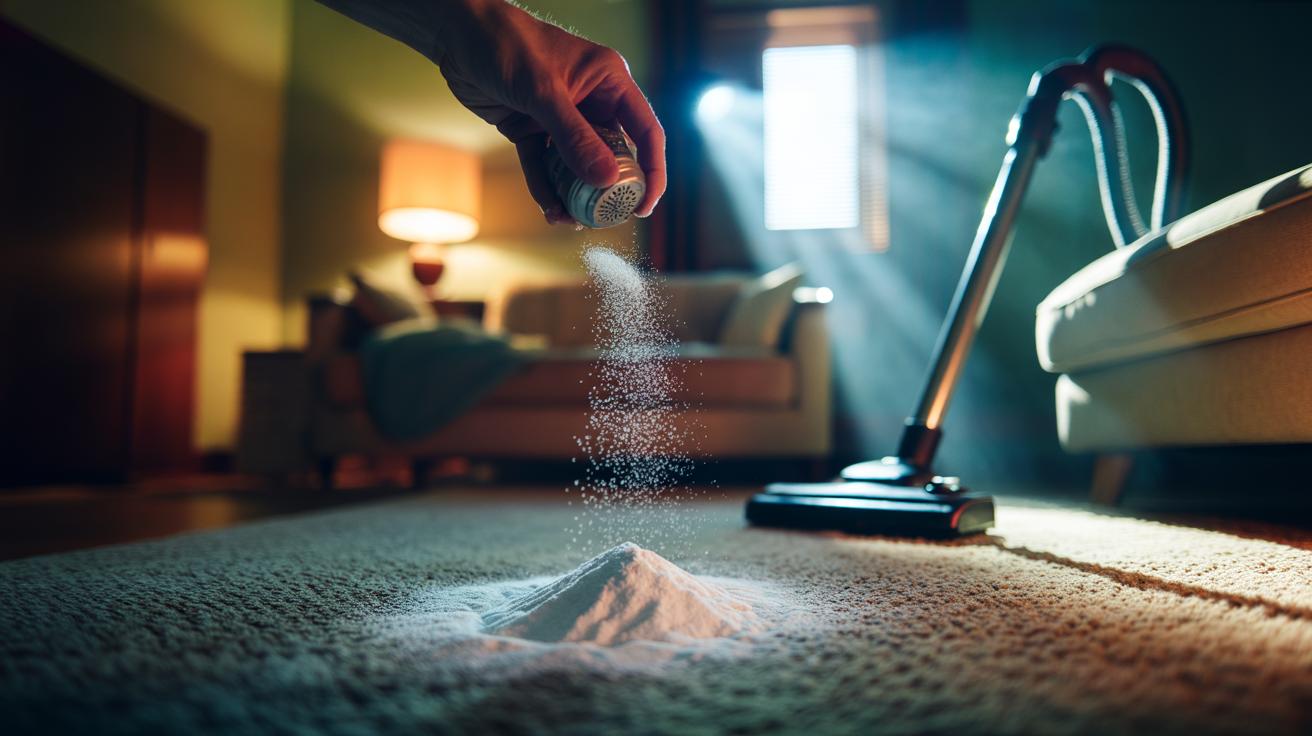
Start with a slow vacuum to remove loose dust. Test a small, hidden patch, then shake a fine, even layer of baking soda—roughly 2–3 tablespoons per square metre. Use a shaker or sieve for control. Work it lightly into the pile with a soft brush so particles nestle among fibres, where the smells live. Do not wet the powder; a paste can lodge deep and be difficult to remove. Open a window a crack. Keep pets and children off the treated area. Now wait: 8–12 hours is the sweet spot, and overnight is convenient and quiet.
In the morning, vacuum thoroughly. Go slowly in overlapping passes to lift every grain. If you use a bagged vacuum, consider a fresh bag; captured odours can linger there. HEPA filtration helps in sensitive homes. For persistent smells, repeat the routine or combine with targeted cleaners after vacuuming. Never mix bicarbonate and vinegar on the carpet; you’ll get fizz, water, and a neutralised solution that carries odours deeper into the backing.
| Odour Source | Typical Amount | Dwell Time | Notes |
|---|---|---|---|
| Pet accidents (dried) | 3 tbsp/m² | Overnight | Repeat after enzymatic cleaner if needed |
| Cooking smells | 2 tbsp/m² | 8–10 hours | Ventilate lightly |
| Tobacco smoke | 3 tbsp/m² | 12 hours | Pair with fabric airing |
| Musty rooms | 2–3 tbsp/m² | Overnight | Address damp source |
Science In Everyday Life: From Pet Pongs To Smoke
Real homes present messy chemistry. Pet urine starts slightly acidic, then shifts alkaline as it ages and breaks down into ammonia. Sodium bicarbonate helps along the way by adsorbing stray VOCs and buffering the acidic phase, reducing the stingy, sour smell. But if urine has soaked into underlay, the best powder can do is soften the edge; you’ll need enzymatic cleaners to digest the source. For cooking odours—oils, spices, onion sulphur compounds—the powder’s porous microcrystals catch lingering volatiles that fabrics hoard. It’s a quiet mop-up after the meal.
With tobacco smoke, results vary. Bicarbonate can trap some smoky VOCs, yet tarry residues cling to fibres and walls; pairing a sprinkle with laundering curtains and wiping hard surfaces lifts the haze. Mustiness is different again. Those mushroomy notes often ride on excess moisture. Bicarbonate won’t fix damp ingress or mould growth, but it reduces the nose-wrinkling compounds while you tackle leaks and ventilation. The constant is contact time. Whether it’s last night’s curry or a weekend party, the overnight window allows odours to leave the fibres and bind to the powder instead of your air.
Safety, Limitations, And When To Call The Pros
Baking soda is gentle, affordable, and broadly safe for synthetics and most blends. Still, caution is sensible. Avoid aggressive scrubbing on delicate piles, and always patch-test dyed wool or silk; even a mild alkali can unsettle sensitive dyes over repeated use. Don’t use it as a scouring agent—grit plus pressure can fuzz fibres. Minimise dust by sprinkling low, not throwing handfuls, and ventilate lightly. If you’re asthmatic, consider a mask during vacuuming. The goal is to capture odours, not kick up clouds.
There are limits. Deep-set pet urine in underlay, flood damage, or smoke from heavy indoor use may demand professional hot-water extraction, odour-blocking treatments, or replacement of affected padding. Likewise, don’t rely on vinegar foams or perfumed sprays to paper over structural problems like damp walls. See bicarbonate as the first, reliable rung on the ladder: a smart, low-risk intervention that often solves the problem and, when it doesn’t, clarifies the next step. That clarity is valuable. You’ll know when to escalate and when to repeat a simple overnight sprinkle.
A pinch of chemistry and a little patience—that’s the heart of the baking soda trick. By maximising surface contact and letting time do its quiet work, you turn a powder into a powerful deodoriser that respects your carpet and your lungs. It’s not a silver bullet for every situation, but it’s a dependable first response that often spares you harsher measures. Leave it down, sleep on it, vacuum well. Then decide if you need anything more. When your home throws up its next stubborn smell, where will you try your overnight sprinkle first—and what result will you be hoping to wake up to?
Did you like it?4.2/5 (23)