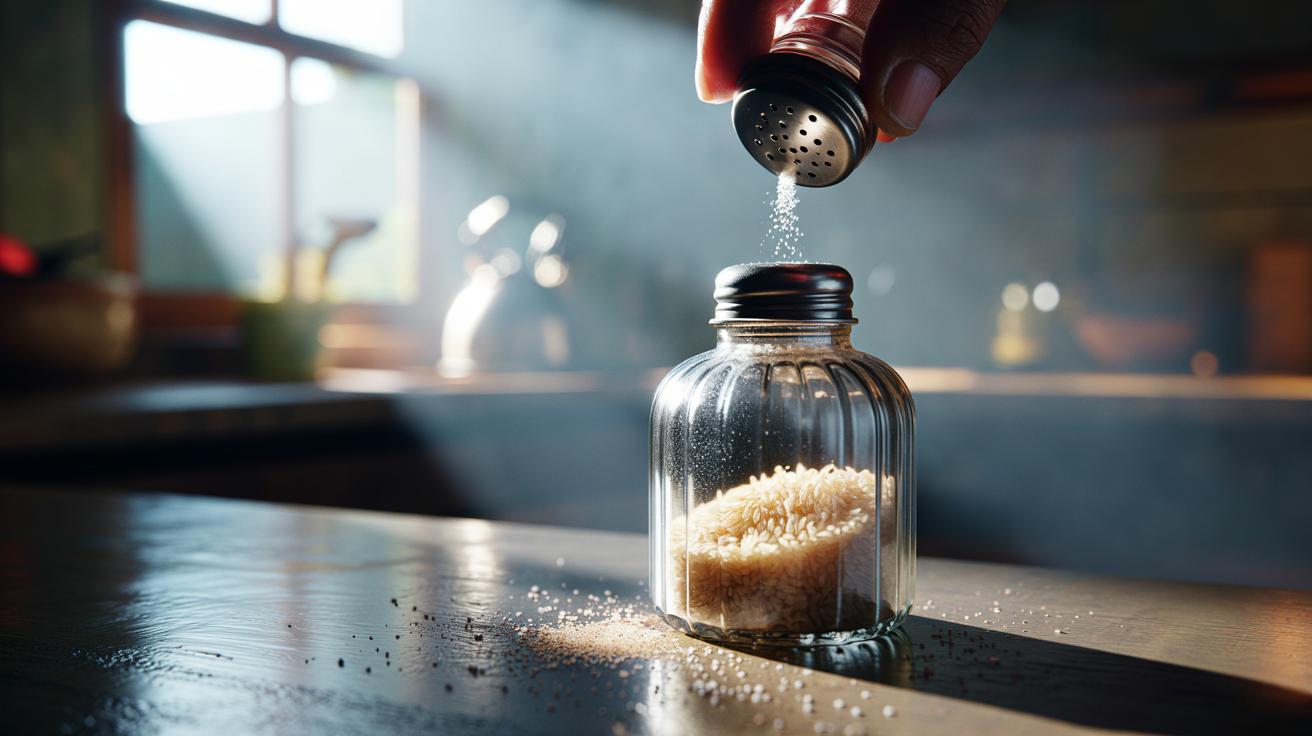
In a nutshell
- 🧂 Salt clumps because it’s hygroscopic; moisture triggers micro-dissolving and recrystallisation “bridges.” Rice lowers local humidity, halting clump formation.
- 🌾 Rice works as a natural desiccant: porous starch granules enable rapid absorption of vapour, stabilising the tiny, semi-closed environment inside a shaker.
- 🧴 How to use: add 1–2 tsp per standard shaker, keep the lid snug, store away from steam, and consider a mesh or filter; refresh both salt and rice when dampness persists.
- 📏 Practical guide: small shakers need ~1 tsp (8–12 weeks), medium ~2 tsp (6–10 weeks), large ~1 tbsp (4–8 weeks); adjust by humidity and usage.
- 🧼 Safety and myths: dry rice is food-safe; avoid non–food-grade silica gel; pasta/beans work slower; rice won’t flavour salt or block holes when used in modest amounts.
British kitchens know the drill: a week of damp weather and the salt suddenly behaves like wet sand. You tap. You shake. Nothing. Then comes the old trick passed down by grandparents and chefs alike—drop a handful of rice into the shaker. It seems almost too simple. Yet it works with surprising reliability, even when the air feels like a seaside fog. In this piece, we unpack the science of why salt clumps, why rice acts as a fast, passive desiccant, and how to use it to keep your seasoning perfectly free-flowing. Practical, inexpensive, and low-tech, this is one kitchen hack that earns its place.
Why Salt Clumps in Damp Kitchens
Salt is not just seasoning; it’s a hygroscopic crystal. In plain terms, sodium chloride attracts water vapour when the surrounding air is sufficiently humid. The problem isn’t only absorption. Tiny droplets condense on the surface of crystals; then, as the water redistributes or evaporates, crystals partially dissolve and recrystallise, forming hard “bridges” between particles. That’s the stubborn clump you end up hammering against the table. Coastal air, steamy dishwashers, and kettle-heavy mornings accelerate this cycle. Iodised salt often contains anti-caking agents, but they can be overwhelmed in a wet week.
High humidity drives micro-melting and re-bonding of salt grains. Coarse sea salt fares no better; bigger crystals simply clump in bigger chunks. Fine table salt, with more surface area, can actually seize faster. Add the fact that shakers trap moisture with every opening, and your condiments turn into static sculptures. The upshot: reduce free water in the shaker and you beat the clump. That’s the entire job description of the rice grains you’re about to add—acting as a quick, cheap moisture sink inside the same micro-environment.
Why Rice Works: Rapid Absorption Explained
Rice is built for rapid moisture uptake. Each grain is a porous composite of starch—amylose and amylopectin—wrapped in a husk-like outer layer. Those starch granules pull in water vapour through capillary action and hydrogen bonding, then hold it in a labyrinth of microscopic cavities. Compared with salt crystals, which dissolve and recrystallise, rice simply grabs the water and sits quietly, lowering the local humidity in the shaker. Lower humidity means no surface dissolve-and-bridge, so no clumps. That’s the mechanism in a nutshell.
In practice, small quantities work astonishingly well because the shaker is a tiny, semi-closed system. Even a teaspoon’s worth of grains can buffer a week of boiling pots and steamy windows. White, long-grain rice is a strong choice: it’s clean, hard, and sheds less dust than broken or ultra-starchy grains. Brown rice contains more lipids and can stale faster. Parboiled is fine. Sushi rice works too, though it’s thirstier and can fracture, creating fine powder. The key is speed. Rice responds within hours and keeps absorbing until it nears equilibrium with the air around it.
How to Use Rice in Your Salt Shaker
Use a small handful—think a teaspoon or two of grains per standard shaker. Rinse and dry the shaker first, then add the rice before refilling with salt. If your shaker has very large perforations, consider placing the rice at the bottom and topping with a coffee filter circle or a small mesh disk to prevent grains from escaping. Keep the lid snug and store away from steam plumes. That alone prevents fresh humidity from undoing the work.
Replace the rice every one to three months, or sooner after a stretch of very muggy weather. If you spot haziness or lingering dampness, refresh both the salt and rice. Don’t overfill the shaker; headspace reduces compaction and improves flow. For finishing salts with delicate flakes, tuck a pinch of rice in a small food-safe sachet or a folded paper wrap to avoid crushing. And if you use flavoured salts, keep rice unscented to preserve aromas. Below is a quick guide to quantities and timing.
| Shaker Size | Rice Amount | Replacement Interval | Notes |
|---|---|---|---|
| Small (100–150 ml) | 1 tsp | 8–12 weeks | Ideal for fine table salt |
| Medium (150–250 ml) | 2 tsp | 6–10 weeks | Add mesh if holes are large |
| Large (250–350 ml) | 1 tbsp | 4–8 weeks | Best kept away from stove steam |
Alternatives, Hygiene, and Common Myths
People ask about silica gel. It’s a powerful desiccant, but most sachets aren’t meant for direct food contact inside a shaker, and the beads can shatter. Better to stick with food-native absorbers. Dried beans? They work, slowly, and take up more space. A few grains of pasta? Acceptable in a pinch. In terms of hygiene, dry rice is safe in a dry salt environment; salt’s low water activity inhibits microbial growth. If rice looks dusty, discoloured, or damp, replace immediately. Wash and dry the shaker thoroughly to reset the microclimate.
Myths persist. No, rice doesn’t “flavour” your salt if you use plain white grains. No, it won’t block the holes if you keep quantities modest. It also doesn’t need to be cooked—uncooked rice is the point. If you prefer a tidier aesthetic, tuck rice in a small, breathable sachet made from clean filter paper. The principle stays identical: create a tiny, efficient moisture sink in the same space as the salt so the crystals never reach the dissolve-and-bridge stage that causes clumping.
Rice in the shaker is a tiny intervention that solves a big kitchen annoyance. It’s cheap. It’s fast. It’s grounded in simple physics and starch chemistry. Add a small handful, keep the lid tight, store the shaker away from steam, and enjoy free-flowing pinches every time. When humidity rises, preparedness beats frustration. If you’ve tried this trick, what tweaks—or alternative desiccants—have you found most effective in keeping your salt perfectly pourable through the dampest British spells?
Did you like it?4.7/5 (24)