In a nutshell
- 🔁 Reflective aluminium foil “recycles” radiant heat via very low emissivity (≈0.03–0.05) and needs an adjacent air gap; it complements, not replaces, bulk insulation.
- 🧭 Orientation is flexible but the air cavity is essential; tape seams for airtightness, keep 20–40 mm gaps, control dust, and put the Vapour Control Layer (VCL) on the warm side to prevent condensation.
- 🏠 Prime use-cases: loft rafter linings, suspended timber floors, foil-backed boards behind radiators, and solid-wall dry-lining—always preserving ventilation, clearances, and treating foil as an enhancer.
- 📊 Low‑e cavities can add ~0.1–0.3 m²K/W to a gap’s R-value, yielding modest U-value gains but noticeable comfort improvements by cutting radiant exchange; materials are inexpensive and quick to fit.
- 🔥 Specify declared emissivity and fire ratings; keep foil clear of electrics and heat sources, and remember Part L compliance still depends on adequate bulk insulation.
Britain’s homes leak warmth like sieves. Loft hatches whistle, floorboards chill your ankles, and rising bills sharpen every draught. A simple tweak is catching attention: layer aluminium foil on existing insulation to “recycle” heat. It sounds like a hack, but there’s physics behind the promise. Smooth, shiny metal has extremely low emissivity, meaning it emits and absorbs very little radiant heat. When you pair that surface with a small air gap, it can bounce infrared energy back to the room side, nudging comfort upwards and loads downwards. Done properly, reflective faces don’t act like thick quilts; they limit radiation across cavities and complement bulk insulation.
How Reflective Foil Actually Keeps You Warmer
Heat moves three ways: conduction (through solids), convection (via air movement), and radiation (infrared exchange between surfaces). Traditional batts and boards slow conduction and, partly, convection. A shiny radiant barrier targets the third path. Highly polished aluminium has an emissivity around 0.03–0.05, compared with painted plasterboard at roughly 0.9. That gulf is transformative. The reflective face absorbs little, emits little, and reflects most incoming infrared back to the warm side, which is why people say it “recycles” heat. The critical detail: the reflective layer must face an adjacent air space. If it’s pressed tight against another solid, conduction dominates and the optical magic vanishes.
Thickness is not the trick here; surface properties are. Give a foil face a 20–40 mm air cavity and the radiant component across that gap can drop by up to 90–95%, depending on dust, orientation, and temperature. Keep that cavity continuous. Tape seams so air cannot pump warmth out. Guard against dust: a dull, dirty foil radiates more and reflects less. And remember, foil doesn’t replace bulk insulation; it complements it by upgrading cavities that would otherwise hemorrhage infrared energy.
Getting Orientation, Air Gaps, and Layers Right
Orientation confuses many. The shiny side can face inwards or outwards and still be low-emissivity; what matters is the adjacent air gap. In heating-led seasons, UK practice often places a vapour control layer (VCL) on the warm side to stop interior moisture drifting into cold layers. Foil facings frequently double as that VCL when seams are taped. Over rafters, you can staple foil membranes beneath insulation to create a service void and radiant barrier; behind plasterboard, maintain a 25 mm cavity. Under floors, staple foil beneath joists and preserve a ventilated gap above a reflective face. Don’t squash or bridge the gap with cables, battens, or blobs of adhesive.
Layering matters. Foil-faced PIR boards deliver conduction control plus low-e surfaces; multi-foil quilts rely on multiple low-e layers separated by controlled cavities. Tape meticulously to avoid convective bypass. Avoid placing plain foil directly on cold masonry without a moisture strategy; interstitial condensation is the stealthy enemy. Where a VCL is needed, it belongs on the room side; outside, use breathable membranes that allow drying. Finally, keep foil clear of live electrics, choose products with appropriate fire ratings, and respect manufacturer clearances around heat sources. Reflective layers are most effective when the build-up is airtight, correctly vented, and intentionally gapped.
Where It Works Best in UK Homes
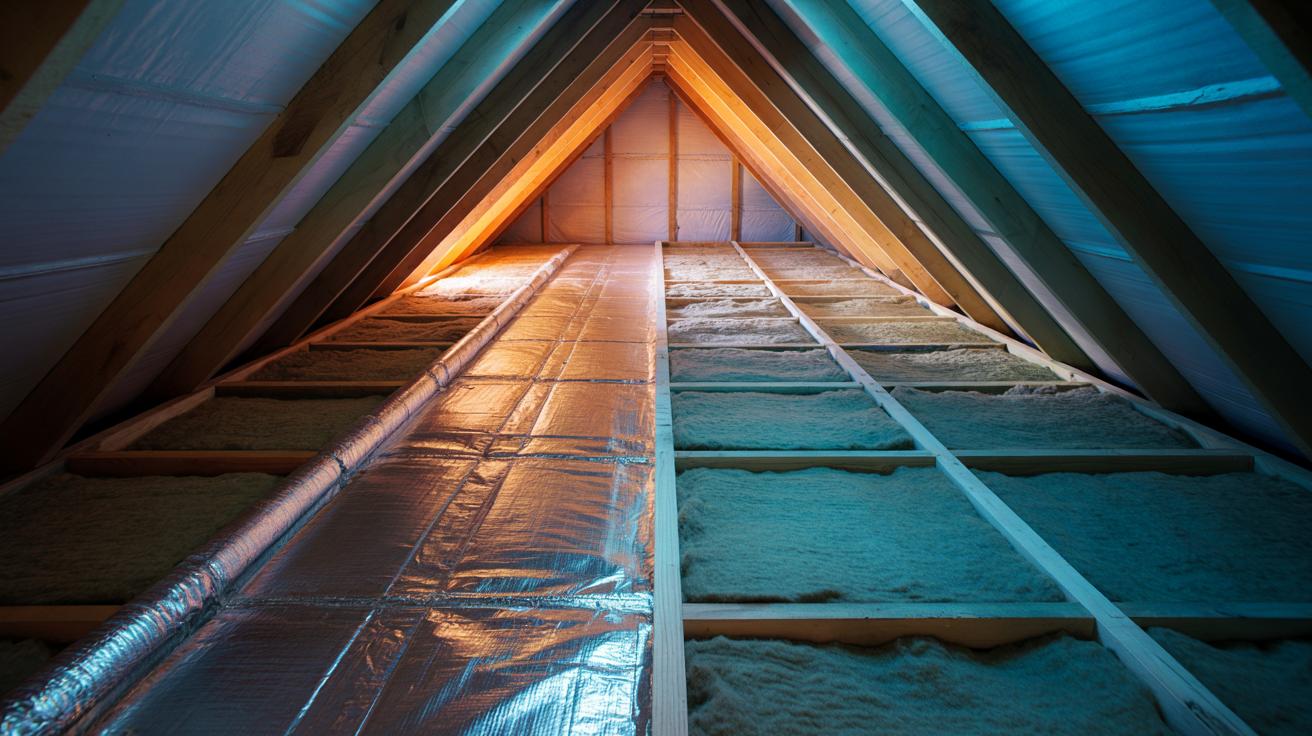
Lofts are low-hanging fruit. Over-ceiling insulation does the heavy lifting, but a foil layer under rafters can reflect radiant gains in summer and trim winter losses, while creating a tidy service zone. In suspended timber floors, a reflective face toward a ventilated void reduces radiant coupling to the cold crawlspace; pair with tight-fitting quilt between joists. Behind radiators on external walls, a thin foil-backed board can reflect infrared back into the room. Use a purpose-made, fire-safe panel and keep clearances; never wrap or cover heaters. For solid-wall homes, foil-faced internal dry-lining can provide both a VCL and a low-emissivity surface adjacent to a controlled cavity, if designed to manage moisture.
Outbuildings, campervans, and garden offices benefit too, where cavities are shallow and thermal budgets tight. Bathrooms and kitchens demand extra care: seal penetrations, maintain the VCL, and specify materials with suitable moisture and fire performance. In all cases, treat foil as an enhancer, not a substitute. Bulk insulation meets Part L targets; reflective layers refine comfort, reduce radiant asymmetry, and smooth cold-surface sensations. Done right, rooms feel less “cold to the touch” even before the thermostat climbs.
Numbers That Matter: Emissivity, R-Values, and Payback
It helps to pin the physics to figures. Emissivity (ε) tells you how readily a surface emits/absorbs infrared. The lower the number, the better the radiant control. A clean, bright aluminium face is exceptionally low-e; painted or dusty surfaces are not. This is why cleanliness and protection from grime matter. In practical terms, adding a low-e cavity can boost the effective R-value of that specific gap by roughly 0.1–0.3 m²K/W, depending on orientation and temperature spread. Across a whole element, the U-value improvement is modest but real, and the perceived comfort gain can be outsized because radiant exchange governs how warm we feel.
| Surface | Typical Emissivity (ε) | Notes |
|---|---|---|
| Shiny aluminium foil | 0.03–0.05 | Excellent low-e; protect from dust |
| Dulled/oxidised foil | 0.2–0.3 | Performance drops with grime |
| Painted plasterboard | ~0.9 | High-e; strong radiant exchange |
Economics? Rolls and tapes are inexpensive compared with re-insulating, and installation is quick in accessible lofts and floors. Yet don’t expect miracles or regulatory compliance from foil alone. Part L compliance still rests on adequate thickness of bulk insulation and tested assemblies. Choose products with declared emissivity and, where required, Euroclass fire ratings; beware condensation by placing the VCL on the warm side and maintaining ventilation where design demands. Done with intent, reflective layers trim losses, sharpen comfort, and offer a tidy, reversible upgrade path.
In short, aluminium’s low-emissivity face doesn’t “create” heat; it steers it, reducing radiant losses while bulk insulation slows conduction. That interplay can make rooms feel calmer, less draught-bitten, and cheaper to run. The trick is simple: preserve a clean reflective face and a small air gap, tape the seams, and respect moisture and fire rules. If you were to add one reflective layer this season, where would it deliver the most comfort in your home—and what’s the biggest constraint standing in your way?
Did you like it?4.5/5 (22)